Category: The Lighter Side of Aging

Cathy Speer – Live Folk, Celtic, and Spiritual Music For Senior Events

Blog Post by Cathy Speer, Senior Entertainer, Celtic Folk Singer and Guitar

(Note by Mike Brunt, Local Owner for Home Instead Senior Care: In my 7 years of serving seniors, I have hired Cathy to perform at retirement communities and senior centers. Her music and presentation have always been popular with my groups, and I personally have her CD in my car. I can recommend her without reservation.)

———————————

I have been playing acoustic guitar, singing, and writing songs since I was 13. Many people have said that my music has a therapeutic, soothing effect on them. My grandmother’s Bluegrass background and Scottish roots were a big influence to me musically, as I grew up listening to her harmonies and country fiddle playing.

Celtic and folk songs are my specialty, although I play other music as well, including hymns. AND, I love when audiences sing with me! I am a mom of 9, and two of my very talented, younger sons sometimes perform with me. In addition to playing music for seniors in any venue, I also provide music at weddings, church functions, and restaurants. Plus, I love to play holiday music!

I am based in Hillsboro, but am happy to travel to the mid-valley and even to the coast. Travel expenses may apply depending on the distance.

Provided here is a sample of my music to give you a sense of my sound and musical style.


Play “Farewell to Tarwathie” performed by Cathy Speer


Please contact me today for more information or to schedule a performance.

Cathy Speer
503-453-3064
callmekate56@yahoo.com


My Client: Lt. Colonel, Pilot in 3 Wars, Jogger, Scuba Diver, Foodie, Bostonian

Senior Companionship by Home Instead CAREGiver Enriches Client’s Life Through Outings and Activities.

(Photo taken by CAREGiver of client, Milt, at the Evergreen Air and Space Museum, standing next to one of the actual planes he piloted during his military career.)

Blog Post by Mike Brunt, Franchise Owner, Home Instead Senior Care

Some people who work for me tell me that I tend to repeat myself. One of my favorite things to repeat to my wonderful CAREGivers is that no matter what they are doing with or for our clients, they need to “add value.” What I mean is this – actively look for and find ways to make the clients’ lives more enjoyable and then do those things without necessarily being asked to do so.

My favorite example this month of a CAREGiver adding value to a client’s life is my CAREGiver, Katie, who takes care of my client, Milt. Milt grew up outside of Boston as the son of a fisherman. He has had a distinguished military career in which he rose to the rank of Lieutenant Colonel, was a pilot in 3 wars, and lived in Hawaii for 32 years. Milt has jogged almost every day of his life, enjoyed scuba diving, and is very knowledgeable about the food business.

Since July 2011, Katie has worked weekly on Tuesdays and Thursdays with Milt. During her four hour afternoon shifts, she takes him by car or MAX on outings for exercise, errands, mental stimulation, and social engagement outside of the community in Beaverton where he and his wife live.

Katie and Milt frequently visit Lloyd Center in northeast Portland where he enjoys window shopping and watching the ice skaters. Other trips have included visits to the Oregon Zoo, World Forestry Center, OMSI, Newport Aquarium, and Evergreen Aviation and Space Museum. Milton really enjoys seeing planes and military exhibits.  Later this month, she’s taking him on the Portland Sternwheeler for a river cruise and hopes that it will be a sunny day.

I find so much joy and satisfaction in providing this life enrichment to Milt through my stellar CAREGiver Katie. She is “living Home Instead” and truly adding value for Milt in the later years of what has been a fascinating life.


Family Caregiver Vignette – The Magic of Mail for Seniors

Blog Post by Marcia Solberg

Dear Family Members,

Allow me to introduce myself, my name is Marcia Solberg, and I thank Mike Brunt at Home Instead Senior Care for the opportunity to share my story. Nine years ago, my 90 year old father made the decision to give up his home of 46 years in Great Falls, Montana and move to assisted living. As you know, many emotions play into this life change, especially for the children who live miles away from their parents and worry about their well being and happiness.

Every time I visited, I noticed that the most important sign at his retirement residence was the MAIL’S IN sign above the resident mail boxes. However, it broke my heart when I observed that very few people actually were able to find any mail in their box on any given day.

Five years ago, I discovered an internet service called Send Out Cards. This amazing web site allowed me to upload family pictures and create wonderful greeting cards that were printed, stuffed and stamped in Salt Lake and sent by US mail. What joy my dad and I both shared when he received my cards and picked up the phone to call and thank me.  I tried to send one every week, as well as on special occasions, after a trip, or with pictures of a great grand-child’s birthday.

When I visited, I knew just how much those cards meant when other residents would greet me with, “Oh, you’re the daughter that sends those GREAT cards!” Those cards made dad a Very Important Person at the Rainbow Retirement home. I believe the only other person to receive more mail was Walter Breuning, the world’s oldest man. (passed away last year at 114!) Dad passed away in December 2009, at the age of 96, having lived a wonderful life. In his desk drawer I found every card I had sent him for the last year and a half! I am forever grateful that I found the Send Out Cards program. Most of the cards I sent dad cost me 93 cents or less, plus postage, and were much more personal with pictures than anything I could buy at a card shop!

I would be privileged to talk with any family members who might be interested in this program and set up a free gift account for you to try the service. You’ll be able to see just how easy it is, and how much time and money you can save, while touching your loved one’s heart in a very special way. A subscription is now as little as $9.80 a month, which will make 6-10 cards (with & without pictures).

Don’t hesitate to contact me with any questions you might have.

Sincerely,

Marcia Solberg
971-235-2257
marciasolberg@aol.com
Independent Distributor of Send Out Cards
www.sendoutcards.com/cardsbymarcia
Member of Beaverton & Tigard Chamber of Commerce, NAPO Oregon, MSN


Senior Volunteers Contribute $64 Billion of Value to U.S. Economy Each Year

Blog Post by Portland-Area Offices of Home Instead Senior Care

The number of older Americans who volunteer is staggering, and their service has enormous positive, far-reaching impacts on national quality of life and the economy.

Statistical Highlights:

  • Between 2008 and 2010, 18.7 million older adults contributed over 3 billion hours of service.
  • Yearly value of this service to the U.S. economy was over $64 billion.
  • 52% of seniors volunteer their time to unpaid community service.


Do you know any senior volunteers who through simple acts have become heroes to those they serve? Nominate them to receive the recognition they deserve but would never claim for themselves. Nomination form is found online at www.salutetoseniorservice.com.


The video below covers these and more positive statistics about senior volunteerism.


Columbia Community Bank Spotlights Home Instead Senior Care

Client Spotlight – Winter 2012 Quarterly Newsletter, Columbia Community Bank


We all have an elderly friend or relative who would like to stay home as long as possible. Home Instead can make that wish a reality.

The Washington County, Oregon franchise of Home Instead Senior Care was founded in 2005 by Mike Brunt who is the owner, operator, and a certified senior advisor. Mike started the business to help seniors remain safely in the comfort of their homes and to provide support to the family and friends who love them. Home Instead is available to address a variety of concerns and provide non-medical home care services, whether it’s companionship while family members are at work; help with groceries, errands and household tasks; or hands-on help with personal daily routines. Mike’s staff includes scores of caregivers who reside in and provide care in Washington County.

When it was time for Mike to expand his business, he found Ann Hall at Columbia Community Bank, who was willing to figure out a way to structure a loan for his service-based business. “I’m a believer of community based banking,” said Mike. “I like knowing that money is reinvested in the community to help businesses like mine grow.”

One of Home Instead Senor Care’s past clients is Mel, a retired farmer who, with the help of his beloved Home Instead CAREGivers (SM), continued his passion for plants and flowers in his greenhouse.

(Mel holds flowers from his greenhouse with his CAREGiver.)

Photo Above: Mike Brunt going in style with his community outreach director, Jean Blackburn, on their way to serve seniors.


Salute to Senior Service – Nominate An Outstanding Volunteer as Oregon’s “Senior Hero”

Blog Post by Home Instead Senior Care offices in the Portland Metro Area

Video Overview of Senior Volunteerism

The Home Instead Senior Care® locations serving seniors in Washington County have announced the Salute to Senior ServiceSM program to honor senior volunteers for the tireless contributions they make to their local communities.

The program includes a search for the most outstanding senior volunteer in each state and culminates with the selection of a national Salute to Senior Service winner during Older Americans Month in May.


State Senior HeroSM winners will receive plaques, and their stories will be posted on the SalutetoSeniorService.com website. In addition, $5,000 will be donated to the national winner’s nonprofit charity of choice.


According to research conducted by the Home Instead Senior Care® network, 52 percent of seniors volunteer their time through unpaid community service. Nearly 20 percent (one in five) of seniors surveyed started volunteering when they reached the traditional age of retirement – 65 or older. Furthermore, 20 percent of seniors who volunteer say that their community service is the most important thing they do.

“Helping others defines life for many local retired seniors,” said Mike Brunt owner of the Home Instead Senior Care office in Washington County. “And what a difference we have observed in seniors’ health, attitude and outlook among those who choose to stay active as they age.”

Dr. Erwin Tan, director of the Senior Corps, a national organization that links more than 400,000 Americans 55 and older to service opportunities, agrees. “The one thing that I hear constantly from the seniors in our programs is that volunteering gives them a purpose in life – they say that it’s the reason they get up in the morning.

“In addition, it’s a great way for them to learn new things – whether a skill or just something about an issue in which they have an interest,” Tan said. “Volunteering is just a great way to expand their horizons and feel like they’re still a valuable part of their community.”

For more information about the Salute to Senior Service program or Home Instead Senior Care, please go to www.salutetoseniorservice.com or call 503-530-1527.

The Home Instead Senior Care network completed 600 telephone interviews with seniors age 65 and older in the U.S. who currently volunteer their time through unpaid community service. The sampling error is +/-4.0% at a 95% confidence level.


Elderly “Experts” Share Life Advice in Cornell Project

Article by by Jane E. Brody of the New York Times - January 9, 2012
Link to Full Article

Eventually, most of us learn valuable lessons about how to conduct a successful and satisfying life. But for far too many people, the learning comes too late to help them avoid painful mistakes and decades of wasted time and effort.

Enter an invaluable source of help, if anyone is willing to listen while there is still time to take corrective action. It is a new book called “30 Lessons for Living” (Hudson Street Press) that offers practical advice from more than 1,000 older Americans from different economic, educational and occupational strata who were interviewed as part of the ongoing Cornell Legacy Project.

Its author, Karl Pillemer, a professor of human development at the College of Human Ecology at Cornell and a gerontologist at the Weill Cornell Medical College, calls his subjects “the experts,” and their advice is based on what they did right and wrong in their long lives. Many of the interviews can be viewed at legacyproject.human.cornell.edu.

Here is a summary of their most salient thoughts…

On Marriage

On Careers

On Parenting

On Aging

On Regrets

On Happiness

Link to Full Article


Do Stop In To See The Orchids In Their Full Glory

Blog Post by Mike Brunt

Anyone who has worked with seniors, in any way, will be able to relate with me on this. It seems that the most special, and heart-touching moments are born out of common daily experiences.

This is a note I received last week from a new client, Dorothy. It made me feel so happy and so glad I do what I do. It’s amazing how small acts of kindness and gratitude can spark such strong feelings of joy and bonds of fellowship. I’m keeping this note in my back pocket for those who can’t understand why I get so excited about serving seniors.


“Thank you Mr. Brunt for the gorgeous plant of phalaenopsis orchids. Their beautiful shades are just breathtaking. I am so sorry that it took me so long to acknowledge your thoughtfulness. Do stop in to see the orchids in their full glory. Thanks again. You must see the flowers. Your graciousness extended to me was a treasure to behold and receive. Sincerely, Dorothy.”


Laughing with Mary Maxwell – Video

Blog Post by Home Instead Senior Care offices in the Portland Metro Area

She’s the lady that became a YouTube sensation as she delivered a hilarious prayer about growing old, making over 8 million people laugh. Now she’s back by popular demand with her own column with video commentary on CaregiverStress.com! Mary will give advice and share her hilarious take on life in her deadpan comedic style, reminding us again and again that laughter is truly the best medicine.


Book: “Moments This Good, The Softer Side of Alzheimer’s”

Book Recommendation by Mike Brunt

Bonnie Nester’s latest book, ”Moments this Good: The Softer Side of Alzheimer’s,” is a memoir of hope and love.  Join Bonnie as she walks beside her mother through the tangled trails of Alzheimer’s Disease. In “Moments this Good,” Bonnie shares her experiences and insights in a tender and a lovingly humorous way. This is an uplifting, encouraging read to guide others who are losing loved ones to this debilitating disease. Moments This Good gives back the humanity and dignity that Alzheimer’s tries to steal. 

A Portion of the proceeds for this book are donated to the Alzheimer’s Association.

If you would like to purchase a signed and/or personalized copy of any of her books, contact her directly.  She also welcomes any comments – she loves hearing from fellow readers: bonnie@bonnienester.com.

Publication Date: May 2008
ISBN: 9780980244601
208 Pages
26 Black & White Photos
Golden Quill Publishing

Order “Moments this Good”

Read an Excerpt
Bonnie lives in Sherwood, Oregon and is a supporter of Senior Provider Information Network. Learn more about Bonnie and her work at http://www.bonnienester.com/.

The U-Bend of Life, Why People Get Happier As They Get Older

Post by Mike Brunt
Source: The Economist, December 18, 2010

The U-bend of life: Why, beyond middle age, people get happier as they get older


ASK people how they feel about getting older, and they will probably reply in the same vein as Maurice Chevalier: “Old age isn’t so bad when you consider the alternative.” Stiffening joints, weakening muscles, fading eyesight and the clouding of memory, coupled with the modern world’s careless contempt for the old, seem a fearful prospect—better than death, perhaps, but not much. Yet mankind is wrong to dread ageing. Life is not a long slow decline from sunlit uplands towards the valley of death. It is, rather, a U-bend.

Link to full article

CAREGiver Vignette: “You Can’t Go Outside Like That!”

Post by Mike Brunt

One of my wonderful CAREGivers wrote to me about the following experience she had with our client.

CAREGiver Vignette: “You Can’t Go Outside Like That!”

My client, Helen, has Alzheimer’s disease. She requires constant attention, redirection, and verbal cueing. Her elderly husband, Paul, recently had back surgery. One day when Helen and I returned from a walk, Paul was lying on his back in the living room to relieve the pressure on his back. He was wearing only an undershirt and boxers.

After his rest, Paul felt refreshed and decided to check on his tomato plants on the patio, only a few yards away from the golf course greenway. Golfers were right outside, ready to tee off. Helen cautioned him, “You can’t go outside like that!” I thought, “Good for her! She’s very aware today!”

Helen scurried to the bedroom and returned with a clean pair of black socks and black dress shoes. “Should I have brought the brown ones?” she worried. Paul and I shared a smile and assured her she had done very well. Then we all walked out to check on the plants together. Black sox, dress shoes, boxers and all.

Question to Boomers…How Will You Live?

Blog Post by Home Instead Senior Care offices in the Portland Metro Area

Changing the Face of Aging

howwillyoulive.org

As a senior-care professional, you’ve witnessed firsthand the many challenges of aging. But those “golden” years likely will look vastly different for the generations that will be joining the ranks of seniors in the years to come.

After all, the generation ready to embark on their senior years has been writing their own story since day one. They are the generation that led the charge to change the way society looked at so many things from civil and women’s rights to space exploration to technology.

Generations before them may have faced their senior years with apprehension, but not so for those trail-blazers waiting to join the senior ranks. They’ve changed everything else about our world.  Now they have the opportunity to change the face of aging. Perhaps you are among them or even younger. Regardless of your age, here’s your chance to tell it like it is, or like it should be. The Home Instead Senior Care® network wants to help you spread the word.

We invite you to participate and share the conversations that will make a difference in how aging is perceived for your generation and those you care about. Go to HowWillYouLive.org and tell us how you will change the way you age.

Based on your experience working with older adults, what do you hope for as you move into those “golden” years?  A cure for Alzheimer’s disease? To work until you die? To vacation until you die? To look great? To remain at home with a good quality of life? We want to know what you think.

The Home Instead Senior Care network produced and just released a video that will provide you and others in your generation the opportunity to share ideas about aging and how you see yourself growing older.

Changing the perception of aging is important to a senior-care leader such as Home Instead Senior Care. That’s because Home Instead values the contributions that older adults have made to our world. The organization also knows that planning for their senior years is an important key to aging independently.

HowWillYouLive.org

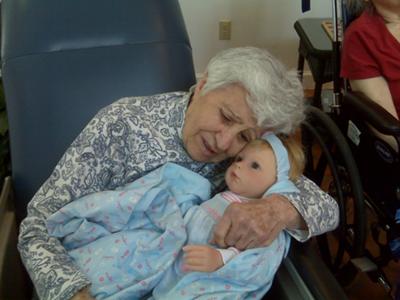
Baby Doll Therapy for Memory Care Residents

Blog Post by Robyn Hosier
Robyn is the Resident Care Coordinator at Clare Bridge Beaverton

Baby Doll Therapy for Memory Care Residents

The Spectrum of Behaviors and Emotions
Day by day we see residents that exhibit a complete spectrum of behaviors and/or emotions.  Situations that arise in the early morning, will certainly give way for something new by the afternoon.   This goes hand in hand with delivering quality dementia and Alzheimer’s care.  Providing an environment that allows for these rapid, daily changes is a challenging and daunting task. As well as, learning how to provide “happiness” and “comfort” to a person with a declining mental state.

Happiness Defined
Happiness can be defined as simply as this, “the satisfaction of needs.”  The needs, however, can change from age to age, year to year and goal to goal.  In dementia care, finding the need that triggers “comfort” can make the difference in dealing with a difficult behavior and a “happy” resident.  Pinpointing what a person requires to be happy and comforted is a talent that caregivers can learn through observation and application.  “Comfort” can be explained best by saying, “to lighten the burden.”  That may leave a lot to the imagination, but can be interpreted as easily as saying, “to make feel better.”

Each Resident – A Unique Individual
When introducing different therapies to residents, it will always enhance your skill set to learn as much about the resident as possible.  Learning what they were like before the Dementia or Alzheimer’s, and since the onset, can prove successful when trying to implement a plan that provides comfort and happiness.  Not every concept will work for every resident.  Remember that each person, prior to diagnosis, was a unique individual with likes and dislikes, talents and skills.  This has not changed.  Each resident is still a unique individual.  Some things do not differ from their essential personality.  It will be your job to learn and determine what will compliment their current needs.

Innate Capacity for Love and Nurturing
The ability to love and the desire to be a needed and useful, contributing member of any society is part of our basic nature.  Our capacity for love and nurturing is, by far, the strongest, innate basic need we have.  This “need” can be utilized to provide comfort and happiness for the dementia/Alzheimer resident. Even when the proficiency of speech and the dexterity of movement have left, love and nurturing can still be a deep desire that needs to be fulfilled.  That fulfillment can provide brief, or not so brief, moments that are  needed for a resident’s mental success.  Brief moments that they may not remember, but  moments that gave them comfort and happiness.   This is why I utilize “Baby Doll Therapy.”

Everyone Loves Babies
On any given day, it becomes apparent that someone is overly agitated, someone is aggressive, someone is non-verbally acting out, someone is reluctant to accept care, someone appears depressed, someone is more confused than usual or someone just needs to be busy with something.  Everyone loves babies.  Male and female residents both benefit from seeing a baby or a child.  When families bring their children or grandchildren or even great grandchildren, the residents will come alive with smiles.  Even when they can’t remember who their visitors are, they remember youth.

Universal Emotional Needs
Introducing baby dolls can provide moments when the resident can love and nurture another human being.  The doll has a symbolic meaning and provides purpose and healing for people with dementia.  Residents will often provide immediate feedback regarding what you do or say.  Or, what they do or see.  A baby doll can satisfy a universal emotional need that isn’t often fulfilled.  Studies show that there are 5 significant emotional needs:

1)  To feel needed and useful

2)  To have the opportunity to care

3)  To have self-esteem boosted

4)  To love and be loved

5)  To express emotions freely

Baby doll therapy can easily accomplish the satisfaction of these needs.  Never does a person feel more accomplished than when caring for someone/something else.  For a lot of my residents, it’s baby dolls.  For others, it’s a stuffed animal that may remind them of a favorite pet.  Both offer a comforting measure and happiness that allows the resident, even in a demented state, to feel as if they are providing and fulfilling a need for someone else.  This is enormous in magnitude when you consider that these residents are completely dependent on others for their own care.  Baby dolls, stuffed animals and the like, let them feel needed instead of always being “in need.”

Case Study – Nadine
Let’s take a look at Nadine.  Nadine came to us after having lived in her own home for 60 years.  Her husband had died several years before.  Family had decided that “mom” wasn’t able to live on her own any longer.  Her dementia had progressed to a point that she was unsafe to be living without supervision.  It was a tough decision for the family.  Guilt and worry clouded their minds and they obsessed over leaving their mother in this new unfamiliar place.  Nadine, however, reacted like most new residents entering a memory care community, with retaliation!

Nadine had been a school teacher for many years.  She had raised her children, tended to the needs of her husband and when he had passed away, she ran her house.  She swam and walked daily.  She cooked her own food, cleaned her house and minded her financial interests.  This is clearly a woman that had been in control for many years.  She began to try and run “our house,” so to speak.  She, still being able to communicate fairly well, was telling other residents where to go and what to do.  She found a dry erase marker (bright red) and began writing her “lessons” on the walls of the community.  She prattled on endlessly about how we were all bad children, residents and staff included, because we didn’t listen to her teachings.  She would write us notes of how to improve our business.  Although the notes were mostly nonsense, to Nadine they showed structure and organization.

Hoping to find just the right balance, her medications were adjusted and readjusted by her physician.  Some changes proved successful, others not so much.  In dementia care, we realize that medications cannot fix everything.  We still train to be knowledgeable in the things that medications cannot help with.  We provide interventions that are resident specific, things that they can relate to from their own personal history.

Well after all the pharmacology and the personal attention, we offered Nadine a baby doll that had been donated.  At first, she thought the baby was mine, as I had asked her to baby-sit for me.  She held the “baby” carefully and was bright as the afternoon sunshine when she stared at the baby’s face.  She spoke to the doll and coddled it like a new mother.  Pretty soon, the baby was hers.  She would find small articles of her own clothing to swaddle around the baby.  She would share her food with the baby.  That is somewhat messy but messes can be cleaned.  She would discuss mothering techniques with other residents and proudly announce that this was her son, even when “he” was dressed all in pink.  To Nadine, this was an area in her life that she had control over.

As time went by, Nadine’s unusual behaviors subsided.  Her attentions were focused on taking care of the baby and not lecturing all of the other residents on how to be good students.  Her demeanor became gentle and she would exchange pleasantries with staff.  Her conversational skills were a bit of “word salad” but pleasant none the less.  Staff began to provide necessities for her and the baby.  A new t-shirt, tiny little diapers, a bottle, a diaper bag and even a stroller.  This was an experiment that proved beneficial for both the staff and the resident.  Everyone was involved in helping Nadine tend to this little baby.

After generating successful results, we began trying this with other residents.  Although this does not work for every resident, it has proved to be a positive experience for most of them.  We included male residents in this assay.  We found that while the males do not necessarily “dote” over the babies like the females, they do find comfort in feeling the infant effigy lying in their arms.  One gentleman will hold the doll during meal times.  We find that if he is holding the baby, he eats more.  This is a man who has had weight loss and is on hospice.  Getting him to eat better has increased his strength.

Results – Pleasing and Surprising
In the beginning we were concerned over what family members might think, after all we don’t want to diminish the dignity of a grown adult.  We found that most families were pleased and surprised at their loved one’s attachment to a doll or stuffed animal.  Most wished they had thought of it themselves.  Now, we are finding that families are bringing in dolls and animals for their mom, dad, grandma, grandpa, etc.  What started off as an attempt to redirect difficult behaviors has turned into a constructive use of creative therapy.

Living In The Moment
Alzheimer ’s disease and Dementia is a grueling end to what should have been a perfect life.  The seconds of clarity, the moments of reminiscing, the security of knowledge will all become parts of the past, which, too, will be forgotten.  In a memory care community, you should be living in the exact moment that you are in.  Offer that moment to your residents and make it special.  It may be forgotten all too quickly, but for an instant, you provided something that made a personal connection.  How priceless the moment is!

Home Instead’s Portland Premier of the Movie, “Lovely, Still”

Blog Post by Home Instead Senior Care offices in the Portland Metro Area

In the mood for a sweet, holiday love story between seniors? Let Home Instead treat you to a night at the movies!

On Friday, October 15, Home Instead Senior Care will be hosting three showings of the movie, “Lovely, Still,” at the Living Room Theater in downtown Portland. Show times will be 4:40 pm, 6:50 pm, and 9:10 pm. As this is a small, intimate theater, seats are limited.

How to Take Part
Referral providers in Washington County who would like to enjoy this wonderful event should email me at mike.brunt@homeinstead.com. Just let me know what show time you are interested in, and I will check for availability and help you with the RSVP process.

About the Movie

With the approach of Christmas causing him to feel lonely in life and love, Robert Malone braves the wintery snow to arrive home from his job at the grocery store only to find a stranger standing in his home. What begins as an odd and awkward encounter quickly blossoms into what appears to be a romantic late life love affair that takes us on a heartfelt and wonderful journey which takes an unexpected turn.

Movie Trailer

Actor, Martin Landau, Endorses Home Instead Senior Care

Laughter is the Best Medicine Video – Over a Million Views

Blog Post by Home Instead Senior Care offices in the Portland Metro Area

Laughter is the Best Medicine Video

If laughter is the best medicine, then a whole lot of people were medicating themselves online with this video last week. With over a million views in just one week, this video has become a phenomenon that is striking a chord with seniors and their loved ones all over the world.

At first glance, there’s no sign that this is going to be funny. Mary Maxwell, an older adult and friend of the couple who founded Home Instead Senior Care, was asked to give the invocation at the company’s 2009 Convention.

Initially it seemed like a normal prayer, but it soon took a very funny turn. Her deadpan delivery and lines like …This is the first time I’ve ever been old… and it just sort of crept up on me … soon had the franchise owners rolling in the aisles. With the timing of a professional comedian, Mary shines a very funny light on the foibles of aging, to the delight of this audience of senior-care experts.

If you enjoy this, please forward it to your friends. Maybe next week will be 2 million views!

Laughter is the Best Medicine Video