Category: Geriatric Psychiatry

Health Risks to Veterans by Specific War or Trauma

Blog Post by Mike Brunt
Content from www.WeHonorVeterans.org

I was talking last week with Liz Fischer from Hospice of Washington County, and she referred me to the web site www.WeHonorVeterans.org. We Honor Veterans is a program of the National Hospice and Palliative Care Organization (NHPCO) in collaboration with the Department of Veterans Affairs (VA).

The program invites hospices, state hospice organizations, Hospice-Veteran Partnerships and VA facilities to join a pioneering program focused on respectful inquiry, compassionate listening and grateful acknowledgment. By recognizing the unique needs of America’s veterans and their families, community providers, in partnership with VA staff, will learn how to accompany and guide them through their life stories toward a more peaceful ending.

One section of the web site, which I have found fascinating and useful in understanding veterans’ care needs, describes health risks unique to each war in recent American history. Factors such as extremely hot or cold climates, medication availability, chemical warfare, exposure to nuclear radiation, and other environmental hazards give each war it’s own array of common negative health effects for veterans.

Learn more about Veterans’ health risks specific to the wars and traumas listed to the right.

What is Geriatric Care Management?

Blog Post by Sandra Hedges, Owner of S.A.G.E. Care Management, LLC

WHAT IS GERIATRIC CARE MANAGEMENT?

Geriatric Care Management encompasses a broad range of services provided by qualified professionals who specialize in understanding the needs of elders and their families. A Geriatric Care Manager (GCM) provides support, guidance, and solutions to meet those needs. Professional Geriatric Care Managers assist elders and their families through the maze of issues that come up during the transitions of aging. Geriatric Care Managers come from a variety of professional disciplines including Licensed Clinical Social Work, Nursing, and Physical and Occupational Therapy. They must be licensed in their fields as well as by the National Association of Professional Geriatric Care Managers (NAPGCM).

One of the most important functions of GCMs is to provide comprehensive and objective assessments that assist elders and their family members in making decisions. The GCM focuses on maintaining the well-being, independence, and dignity of elders while optimizing safety. GCMs specialize not only in meeting the needs of elders, but also in understanding and working within the environment in which the elder exists (such as high conflict families, challenging mental health problems, etc.).

GCMs are trained advocates for elders and serve the primary functions of assessing needs, planning care, coordinating services, and monitoring health. Following is a list of specific duties and roles of the Geriatric Care Manager:

  • Provide crisis intervention
  • Serve as a liaison with other professionals and coordinate a multi-disciplinary team.
  • Facilitate communication with family members who live far away and be a mediator in high-conflict family situations
  • Be the “eyes and ears” at medical appointments
  • Organize details of returning home (enhanced discharge planning)
  • Provide objective home evaluations 
  • Create comprehensive care plans to reduce crises and re-hospitalizations
  • Reduce anxiety for patients and their families
  • Prevent unnecessary hospitalizations
  • Evaluate safety needs in the home and implement changes
  • Locate and arrange qualified in-home caregivers to meet individual needs
  • Provide on-going oversight and management of home care assistance
  • Arrange household management tasks
  • Help with bill organization and payment
  • Counsel during loss and transitions
  • Assist with end of life planning and decision making
  • Organize record keeping
  • Assist with coordination of down sizing / relocation


Choosing the appropriate GCM for your family is all about finding the right “fit.” All GCM’s have different backgrounds, specialties and personalities. This is a person you will be working closely with, so you’ll want to select wisely. The professional management a GCM provides allows adult children and other family members to spend quality time with their senior loved ones. Also, the GCM takes pressure off of families by moderating interpersonal and communication issues. When a smooth pattern is established, the GCM can monitor the situation from the background and be ready to directly re-engage as the situation requires. 

Assisting honored seniors on the path of aging involves many bumps and turns along the way. With a process this fluid, a GCM can be an indispensable partner on the journey – one who can help preserve positive family relations during the elder’s final years and beyond. 

If you are interested in learning more about Geriatric Care Management, please visit the websites below or contact S.A.G.E. Care Management at 503-688-3866 or shedges@sage-gcm.com.

Resources:
www.sage-gcm.com
www.caremanager.org

About Sandra
Sandra Hedges is a Board Licensed Clinical Social Worker and Certified Professional Geriatric Care Manager. She is the owner of S.A.G.E. Care Management, LLC. Sandra is originally from Hillsboro, OR and spent the last 7 years on the East Coast. She attended New York University to earn her Masters of Social Work and moved up to Boson to work as the Director of Geriatric Care Management for Overlook C.A.R.E. She is happy to be back in Hillsboro near her family and to provide Geriatric Care Management services for her community.

Discovery Doubles Genetic Clues to Alzheimer’s

Post by Ann J. Curley, CNN Medical Assignment Manager
Link to article on CNN blog

Discovery Doubles Genetic Clues to Alzheimer’s

Two new reports in Nature Genetics detail the discovery of five new pathways for detecting Alzheimer’s disease, the memory-stealing brain illness that is especially prevalent among the elderly.

Previous research had identified five genes linked to Alzheimer’s disease, or AD. The combined efforts of an international consortium of researchers has raised those known genetic markers to 10.

“We’ve really doubled the number of clues we have about late-onset AD. We have a lot left to do to complete the story of AD genetics, but this is a big step,” said Professor Gerard D. Schellenberg of the University of Pennsylvania, lead researcher for one of the studies.

“Almost as important as the genes discovered is the fact that a large number of investigators are working together to solve the genetics of AD,” Schellenberg said. “We just started an international consortium, IGAP (International Genomics of Alzheimer’s Project), so all the groups that produced both papers are now collaborating.”  IGAP includes scientists from four university research groups and creates a shared database that includes genetic information for more than 40,000 patients.

“Of course, I am a bit biased, but I think this is a big deal,” Schelleberg said.

While the new genetic findings are far from being a cure for Alzheimer’s, Dr. Bill Thies, chief medical and scientific officer of the Alzheimer’s Association praised the findings of both studies, noting their strong methods.

“In the genetics world we’ve had a history of small samples,” Thies said. “The fact that we’ve confirmed some genes in a large group means that it’s real, not a statistical anomaly.” The IGAP will continue to share genetic findings, he said, with the hopes  their research findings will offer keys to unlocking information about all of the routes that Alzheimer’s takes in the body. “The more pathways that we can explore will allow us to make progress for preventing and treating AD eventually.”

Schellenberg said research is at a “critical point” in Alzheimer’s treatment.

“Much attention has been focused on therapies that target A-beta production,” better known as brain deposits that cause plaques and tangles, gumming up the brain’s machinery, he said. But the new genetic findings look at new pathways that merit further study, including one that confirms a previous theory that focuses on the metabolism of cholesterol. Another important theme in the new research is that  “innate immunity” is important in relation to disease susceptibility. That’s the theory that  Alzheimer’s could be part of the body attacking itself because it perceives a threat to its protective immune system.

“This is a really important idea that needs to be followed up,” he said.

5.2 million Americans are currently living with Alzheimer’s disease, according to the Alzheimer’s Association, which estimates that by 2050, as many as 16 million Americans will have the disease.

Congress Endorses a National Plan to Combat Alzheimer’s

With Alzheimer’s Patients Growing in Number, Congress Endorses a National Plan

By PAM BELLUCK
Original Article Published in the New York Times: December 15, 2010

Congress has voted unanimously to create, for the first time, a national plan to combat Alzheimer’s disease with the same intensity as the attacks on AIDS and cancer.

The bill, expected to be signed by President Obama, would establish a National Alzheimer’s Project within the Department of Health and Human Services, to coordinate the country’s approach to research, treatment and caregiving.

Its goal, the legislation says, is to “accelerate the development of treatments that would prevent, halt or reverse the course of Alzheimer’s” and “improve the early diagnosis of Alzheimer’s disease and coordination of the care and treatment of citizens with Alzheimer’s.”

The project would include an advisory council of representatives from agencies like the Centers for Disease Control and Prevention, the National Institutes of Health, the Department of Veterans Affairs, the Food and Drug Administration, the Indian Health Service and the Centers for Medicare and Medicaid Services. Scientific experts, health care providers and people caring for relatives with Alzheimer’s would also be included.

“If you go to war, you have planning, planning, planning,” said Representative Christopher H. Smith, Republican of New Jersey, who co-sponsored the bill. “Well, this is a war on a dreaded disease. We need to bring all the disparate elements together for the greatest possible result.”

While the act itself does not authorize more money, one of the recommendations of the national plan “is likely to be for an increase in research money for Alzheimer’s,” said another co-sponsor of the bill, Senator Susan Collins, Republican of Maine.

“We spend one penny on research for every dollar the federal government spends on care for patients with Alzheimer’s,” she said. “That just doesn’t make sense. We really need to step up the investment.”

The legislation was driven by the rapidly rising number of people with Alzheimer’s — about 5.3 million now, and expected to triple by 2050. The cost of their care to Medicare and Medicaid was about $170 billion last year. By 2050, Ms. Collins said, it will grow to $800 billion a year, more than the military budget.

The House passed the bill on Wednesday, and the Senate last Thursday.

The advisory council would draft an annual report on federally financed programs involving research, treatment, nursing homes and home care, recommending which to expand or eliminate. It would also ensure that members of ethnic and racial groups at higher risk for Alzheimer’s be included in research and treatment.

Alzheimer’s experts said the effort could make a significant difference.

“What really makes this so powerful is that it takes us from a lot of small efforts going on locally to doing something in a coordinated way,” said Dr. Kenneth Kosik, a neuroscientist at the University of California, Santa Barbara. “If there’s one thing we know in science it is that to draw conclusions we need numbers, large-size populations to study.”

The national plan will reinforce efforts to detect brain changes that occur years before people develop symptoms of dementia, and to develop drugs to prevent or substantially delay symptoms.

“Dealing with symptoms only after the fact is not going to solve the problem,” said Dr. Zaven Khachaturian, a former director of Alzheimer’s research for the National Institutes of Health. Delaying symptoms for just five years, he said, “we will cut down tremendously” on the number of people who live long enough to develop Alzheimer’s.

Representative Edward J. Markey, a Massachusetts Democrat who co-sponsored the bill, said his mother had had Alzheimer’s. “We’re trying to create a sense of urgency so that we’re developing multiple pathways that ultimately might be successful,” he said. “We’ve done it with polio, we’ve done it with AIDS.

“It’s a unique disease to the extent that patients can’t lobby for themselves, and the person close to them cannot lobby because they’re home taking care of that person. There are no Alzheimer’s survivors.”

A version of this article appeared in print on December 16, 2010, on page A26 of the New York edition.

Baby Doll Therapy for Memory Care Residents

Blog Post by Robyn Hosier
Robyn is the Resident Care Coordinator at Clare Bridge Beaverton

Baby Doll Therapy for Memory Care Residents

The Spectrum of Behaviors and Emotions
Day by day we see residents that exhibit a complete spectrum of behaviors and/or emotions.  Situations that arise in the early morning, will certainly give way for something new by the afternoon.   This goes hand in hand with delivering quality dementia and Alzheimer’s care.  Providing an environment that allows for these rapid, daily changes is a challenging and daunting task. As well as, learning how to provide “happiness” and “comfort” to a person with a declining mental state.

Happiness Defined
Happiness can be defined as simply as this, “the satisfaction of needs.”  The needs, however, can change from age to age, year to year and goal to goal.  In dementia care, finding the need that triggers “comfort” can make the difference in dealing with a difficult behavior and a “happy” resident.  Pinpointing what a person requires to be happy and comforted is a talent that caregivers can learn through observation and application.  “Comfort” can be explained best by saying, “to lighten the burden.”  That may leave a lot to the imagination, but can be interpreted as easily as saying, “to make feel better.”

Each Resident – A Unique Individual
When introducing different therapies to residents, it will always enhance your skill set to learn as much about the resident as possible.  Learning what they were like before the Dementia or Alzheimer’s, and since the onset, can prove successful when trying to implement a plan that provides comfort and happiness.  Not every concept will work for every resident.  Remember that each person, prior to diagnosis, was a unique individual with likes and dislikes, talents and skills.  This has not changed.  Each resident is still a unique individual.  Some things do not differ from their essential personality.  It will be your job to learn and determine what will compliment their current needs.

Innate Capacity for Love and Nurturing
The ability to love and the desire to be a needed and useful, contributing member of any society is part of our basic nature.  Our capacity for love and nurturing is, by far, the strongest, innate basic need we have.  This “need” can be utilized to provide comfort and happiness for the dementia/Alzheimer resident. Even when the proficiency of speech and the dexterity of movement have left, love and nurturing can still be a deep desire that needs to be fulfilled.  That fulfillment can provide brief, or not so brief, moments that are  needed for a resident’s mental success.  Brief moments that they may not remember, but  moments that gave them comfort and happiness.   This is why I utilize “Baby Doll Therapy.”

Everyone Loves Babies
On any given day, it becomes apparent that someone is overly agitated, someone is aggressive, someone is non-verbally acting out, someone is reluctant to accept care, someone appears depressed, someone is more confused than usual or someone just needs to be busy with something.  Everyone loves babies.  Male and female residents both benefit from seeing a baby or a child.  When families bring their children or grandchildren or even great grandchildren, the residents will come alive with smiles.  Even when they can’t remember who their visitors are, they remember youth.

Universal Emotional Needs
Introducing baby dolls can provide moments when the resident can love and nurture another human being.  The doll has a symbolic meaning and provides purpose and healing for people with dementia.  Residents will often provide immediate feedback regarding what you do or say.  Or, what they do or see.  A baby doll can satisfy a universal emotional need that isn’t often fulfilled.  Studies show that there are 5 significant emotional needs: 

1)  To feel needed and useful

2)  To have the opportunity to care

3)  To have self-esteem boosted

4)  To love and be loved

5)  To express emotions freely

Baby doll therapy can easily accomplish the satisfaction of these needs.  Never does a person feel more accomplished than when caring for someone/something else.  For a lot of my residents, it’s baby dolls.  For others, it’s a stuffed animal that may remind them of a favorite pet.  Both offer a comforting measure and happiness that allows the resident, even in a demented state, to feel as if they are providing and fulfilling a need for someone else.  This is enormous in magnitude when you consider that these residents are completely dependent on others for their own care.  Baby dolls, stuffed animals and the like, let them feel needed instead of always being “in need.”

Case Study – Nadine
Let’s take a look at Nadine.  Nadine came to us after having lived in her own home for 60 years.  Her husband had died several years before.  Family had decided that “mom” wasn’t able to live on her own any longer.  Her dementia had progressed to a point that she was unsafe to be living without supervision.  It was a tough decision for the family.  Guilt and worry clouded their minds and they obsessed over leaving their mother in this new unfamiliar place.  Nadine, however, reacted like most new residents entering a memory care community, with retaliation!

Nadine had been a school teacher for many years.  She had raised her children, tended to the needs of her husband and when he had passed away, she ran her house.  She swam and walked daily.  She cooked her own food, cleaned her house and minded her financial interests.  This is clearly a woman that had been in control for many years.  She began to try and run “our house,” so to speak.  She, still being able to communicate fairly well, was telling other residents where to go and what to do.  She found a dry erase marker (bright red) and began writing her “lessons” on the walls of the community.  She prattled on endlessly about how we were all bad children, residents and staff included, because we didn’t listen to her teachings.  She would write us notes of how to improve our business.  Although the notes were mostly nonsense, to Nadine they showed structure and organization.

Hoping to find just the right balance, her medications were adjusted and readjusted by her physician.  Some changes proved successful, others not so much.  In dementia care, we realize that medications cannot fix everything.  We still train to be knowledgeable in the things that medications cannot help with.  We provide interventions that are resident specific, things that they can relate to from their own personal history. 

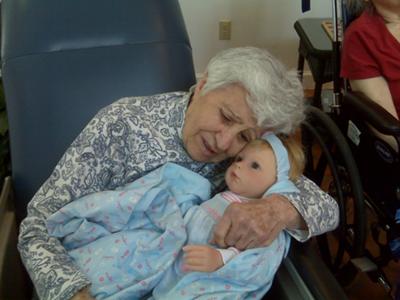
Well after all the pharmacology and the personal attention, we offered Nadine a baby doll that had been donated.  At first, she thought the baby was mine, as I had asked her to baby-sit for me.  She held the “baby” carefully and was bright as the afternoon sunshine when she stared at the baby’s face.  She spoke to the doll and coddled it like a new mother.  Pretty soon, the baby was hers.  She would find small articles of her own clothing to swaddle around the baby.  She would share her food with the baby.  That is somewhat messy but messes can be cleaned.  She would discuss mothering techniques with other residents and proudly announce that this was her son, even when “he” was dressed all in pink.  To Nadine, this was an area in her life that she had control over.

As time went by, Nadine’s unusual behaviors subsided.  Her attentions were focused on taking care of the baby and not lecturing all of the other residents on how to be good students.  Her demeanor became gentle and she would exchange pleasantries with staff.  Her conversational skills were a bit of “word salad” but pleasant none the less.  Staff began to provide necessities for her and the baby.  A new t-shirt, tiny little diapers, a bottle, a diaper bag and even a stroller.  This was an experiment that proved beneficial for both the staff and the resident.  Everyone was involved in helping Nadine tend to this little baby.

After generating successful results, we began trying this with other residents.  Although this does not work for every resident, it has proved to be a positive experience for most of them.  We included male residents in this assay.  We found that while the males do not necessarily “dote” over the babies like the females, they do find comfort in feeling the infant effigy lying in their arms.  One gentleman will hold the doll during meal times.  We find that if he is holding the baby, he eats more.  This is a man who has had weight loss and is on hospice.  Getting him to eat better has increased his strength.

Results – Pleasing and Surprising
In the beginning we were concerned over what family members might think, after all we don’t want to diminish the dignity of a grown adult.  We found that most families were pleased and surprised at their loved one’s attachment to a doll or stuffed animal.  Most wished they had thought of it themselves.  Now, we are finding that families are bringing in dolls and animals for their mom, dad, grandma, grandpa, etc.  What started off as an attempt to redirect difficult behaviors has turned into a constructive use of creative therapy. 

Living In The Moment
Alzheimer ’s disease and Dementia is a grueling end to what should have been a perfect life.  The seconds of clarity, the moments of reminiscing, the security of knowledge will all become parts of the past, which, too, will be forgotten.  In a memory care community, you should be living in the exact moment that you are in.  Offer that moment to your residents and make it special.  It may be forgotten all too quickly, but for an instant, you provided something that made a personal connection.  How priceless the moment is!

When Too Much Stuff Becomes a Household Hazard

Blog Post by Mike Brunt

Breaking Point – When Too Much Stuff Becomes a Household Hazard

Those of us who spend any amount of time with seniors in their private homes or apartments know that most seniors find comfort in their familiar surroundings and treasured possessions. Although there is generally a natural tendency to accumulate things over a long period of time, seniors who have an especially hard time parting with their “stuff” can put themselves and their homes at risk.

“A lifetime accumulation of belongings combined with an influx of daily junk mail, bills, newspapers and magazines can quickly overwhelm seniors who are struggling physically, mentally, or emotionally,” said Paul Hogan, CEO and Co-Founder of the Home Instead Senior Care network.

The risks of overcluttered homes are many including slipping on loose papers, the threat of fire, and health effects of mold and mildew. I have been in the home of a senior who collected free food items that were donated to her local senior center. Her cupboards, counters, and multiple refrigerators and freezers were at maximum capacity and she had actually started stacking food on the floors. This kind of hoarding is obviously not a part of normal aging, but sometimes, the line between normal accumulation and pathological hoarding is hard to define.

Home Instead Senior Care has developed a public information campaign to address the problem of clutter creep. I really like the information because it goes beyond the idea of “just needing to clean up” and addresses the emotional attachments to things and the inability to organize that many seniors experience. Many times seniors’ objects have multi-generational significance to them and even help to tell their life stories. They can feel a strong responsibility to carry on the tradition and bequeath their things to others.

The web site for this public information campaign is called Breaking Point: Decoding the Problem of Seniors and Hoarding. Here you will find relevant and useful resources including the following:

  • “10 Reasons Seniors Hang On To Stuff”
  • “If Your Senior Won’t Let Go…”
  • “A Caregiver’s Guide to Spot Clutter Creep”
  •  

    Also, here is a link to a recent article in the New York Times about this topic.

    Hospital Delirium – 6 Questions to Protect Elderly Patients

    HOSPITAL DELIRIUM – 6 QUESTIONS TO PROTECT ELDERLY PATIENTS
    By PAM BELLUCK, New York Times, June 24, 2010
    Article first appeared on New York Times site

    This week, Pam Belluck reported in The Times on the risk that elderly patients may become confused and delirious while in the hospital. Here she offers advice on how to prepare when an elderly patient is headed to surgery or a hospital stay.

    About a third of patients over age 70 experience hospital delirium, and the consequences can be serious, delaying a patient’s recovery and even leading to placement in a nursing home. Elderly patients who experience delirium are also more likely to develop dementia later on, and more likely to die sooner than patients who do not become delirious.

    Many readers have asked me what family members can do to help lower an elderly patient’s risk. To find out, I turned to three experts –  Dr. Margaret Pisani at the Yale University School of Medicine, Dr. Wes Ely at Vanderbilt University School of Medicine and Dr. Sharon Inouye at Harvard Medical School. Based on their advice, here are six questions family members should ask to lower an elderly patient’s risk for hospital delirium.

    1. Do the nurses and doctors routinely screen for delirium or identify high-risk patients?

    Older and younger patients who develop severe infections or heart, liver or kidney problems are at higher risk for delirium. But about 75 percent of delirium cases are missed when the hospital or its intensive care unit is not actively screening for it. While delirium can cause patients to become aggressive, disruptive or incoherent, it can also manifest itself in much less obvious ways, making a patient seem withdrawn or disconnected. Even with regular screening, family members are often the first to notice subtle changes. If you detect new signs that could indicate delirium — like  confusion, memory problems or personality changes — it is important to discuss these with the nurses or physicians as soon as you can.

    2. How does the hospital deal with agitation or delirium in patients if it develops?

    The longer the duration of the delirium, the greater the chances of poor consequences for the patient, so it should be addressed quickly. Experts say hospitals can treat delirium by helping patients sleep, making sure patients are hydrated, allowing family members to stay at patients’ bedsides to help them become reoriented, and getting patients up and walking when it is safe to do so. Family members should also inquire about hospital policies involving restraints for confused patients. Removing restraints is often recommended because they can cause patients to feel paranoid or trapped. Some hospitals use anti-psychotic medications like haloperidol, but some experts caution that these should be used in moderation and are not yet proven to work.

    3. What does the hospital do to keep patients from becoming disoriented?

    Situations like being without one’s eyeglasses, being in a darkened room and being unaware of the day and time can trigger delirium. Hospital rooms should have clocks, calendars and adequate light, and nurses and doctors should ensure that patients have their glasses, hearing aids and dentures. Family members should make sure the hospital staff knows if the patient needs these items. The family can also bring a few familiar objects from home to help a patient stay oriented. Things like family photos, a favorite blanket for the bed, a beloved book or relaxation tapes can be comforting for all patients. Family members can also help by speaking in a calm, reassuring tone of voice and reminding the patient where he or she is and why.  Massage can be soothing for some patients, and if it is all right with the medical staff, family members can walk with the patient in the hallways. Families should limit the length of visits and number of visitors to prevent patients from feeling overwhelmed, but they should also try to make sure the patient is rarely alone. If the patient experiences an acute episode of delirium, relatives should try to arrange shifts so someone can be present around the clock.
    4. What policies are in place to make sure patients get adequate sleep?

    Family members should find out if patients are able to sleep through the night or if they will be awakened for medical tests. Find out how the hospital controls noise and whether it offers any nondrug measures like back rubs or warm tea to promote sleep.

    5. If my family member needs a urinary catheter or other bedside interventions, how does the hospital decide when to remove them?

    A common procedure like a catheter insertion can spur anxiety in frail, vulnerable patients. Experts say it’s important to remove catheters, intravenous lines and other equipment whenever possible because they can make patients feel trapped, leading to delirium.

    6. Will the physicians and pharmacy staff review my family member’s medications to identify medications that increase delirium risk?

    Bring to the hospital a complete list of all medications and dose instructions, as well as over-the-counter medicines. It may help to bring the medication bottles as well. Prepare a “medical information sheet” listing all allergies, names and phone numbers of physicians, the name of the patient’s usual pharmacy and all known medical conditions. Also, be sure all pertinent medical records have been forwarded to the doctors who will be caring for the patient.