Category: Family Caregivers

Live Training Sessions for Alzheimer’s Family Caregivers, Starting May 22

Blog Post by Mike Brunt, Franchise Owner, Home Instead Senior Care


OVERVIEW

By now, many of you have heard about our free online courses for family caregivers who are taking care of loved ones with Alzheimer’s or other dementias. Now we are taking this training to the next level by offering free live workshops covering essential topics for Alzheimer’s family caregivers. Please call today to reserve your seat in this valuable educational opportunity.

The training was developed by Home Instead Senior Care in consultation with a nationwide panel of experts and will run over the course of 3 weeks with a 1.5 hour session each week. We will take a group of around 10 family caregivers through the courses sequentially as each course builds on the previous one.

In Washington County, we will be offering this series of classes several times in 2012. Our first round starts on Tuesday, May 22 and is detailed below:

LOCATION

Home Instead Senior Care Office
12194 SW Scholls Ferry Rd., Tigard, 97223

CALL TO REGISTER

503-530-1527

TRAINER

Jean Blackburn, Gerontology Specialist

Jean has earned a special certificate from PCC’s Gerontology Department  in “Advanced Behavioral and Cognitive Awareness.” Jean has been a High School Teacher, VP of operations in a training seminar company, has worked for Home Instead Senior care for about 2 years, and most importantly, has been a family caregiver for 10 years for her aging mother who had Alzheimer’s disease. It was the personal experience Jean had with the care of her Mother that inspired her to be of service to other seniors and work with like-minded people. Jean is a dedicated life-long learner who enjoys spending time with her family and friends, with emphasis on her 1-yr.-old Grandson, as well as hiking, exercising, reading, volunteering with “Elders in Action,” and trying new things.

DATES, TIMES, TOPICS COVERED

Date: Tuesday, May 22, 2012; 6:30 – 8:00 p.m.

ALZHEIMER’S DISEASE OR OTHER DEMENTIAS

  • Learn to recognize the symptoms of Alzheimer’s disease or other dementias.
  • Discover how Alzheimer’s disease and other dementias are diagnosed.
  • Understand more about the behaviors that can be caused by the symptoms of Alzheimer’s disease and other dementias.


CAPTURING LIFE’S JOURNEY (SM)

  • Discover how “Capture Life’s Journey” can help you and others provide the best care for your loved one.
  • Learn techniques to encourage your loved one to share their stories and memories.
  • Become familiar with the format of the Life Journal and how to record information about your loved one’s past.
  • Find out how to use the Life Journal in partnership with professional caregivers.


Date: Tuesday, May 29, 2012; 6:30 – 8:00 p.m.

TECHNIQUES TO HANDLE CHALLENGING BEHAVIORS

  • Learn more about the challenging behaviors that may be displayed by those with Alzheimer’s or other dementias.
  • Discover techniques to help handle these behaviors.
  • Determine what techniques work best to manage different types of behaviors.


Date: Tuesday, June 5, 2012; 6:30 – 8:00 p.m.

ACTIVITIES TO ENCOURAGE ENGAGEMENT

  • Learn about the benefits of staying active for a person with Alzheimer’s disease or other dementia.
  • Learn about three types of activities — for mind, body, and soul.
  • Discover various techniques to encourage your loved one to engage in an activity.
  • Become familiar with activities that are suitable for late stage Alzheimer’s disease or other dementia, to stimulate your loved one’s five senses.


Free Alzheimer’s e-Learning Courses for Family Caregivers

Blog Post by Mike Brunt, Local Owner, Home Instead Senior Care
on behalf of all Portland Area Home Instead Locations

This series of online training courses will give you basic information about Alzheimer’s disease and other dementias. More importantly, you will gain valuable insight for providing better care for a loved one with these conditions.

At the end of the course you will be equipped with several techniques to help improve both your and your loved one’s quality of life.

Each class can be completed within 5-15 minutes. No preregistration required.

At the end of each class you can download a Class Checklist PDF.

(Below is a review from Tina Jackson, a trusted employee who has coordinated service for my clients and CAREGivers for 3.5 years.)

I just completed this course, and was very impressed by the way the information was presented.  The information was simple and clear, the graphs were informative and eye-opening, and the testimonials and interactive role-playing allow the reader to see the suggestions in action.  The maps of the houses describing different ways to redirect in different rooms of the house, or various safety hazards to consider, is again, very simple and thought provoking.  I also like how the information stresses the importance of family caregivers taking care of themselves too.

To me, the information was presented in a way that seemed thorough, but not overwhelming, and the option to be able to print a summary of each section allows the reader to be able to keep this information at their fingertips, and/or easily share it with others.

I am more and more impressed with Home Instead Senior Care as time goes on.  I do feel truly blessed to be a part of such a wonderful organization, and to truly value and believe in what we have to offer our community, and whomever else we might impact.  This is an awesome resource I am very excited about.


And Finally, here is one more screen shot from the online training.


Family Caregiver Vignette – The Magic of Mail for Seniors

Blog Post by Marcia Solberg

Dear Family Members,

Allow me to introduce myself, my name is Marcia Solberg, and I thank Mike Brunt at Home Instead Senior Care for the opportunity to share my story. Nine years ago, my 90 year old father made the decision to give up his home of 46 years in Great Falls, Montana and move to assisted living. As you know, many emotions play into this life change, especially for the children who live miles away from their parents and worry about their well being and happiness.

Every time I visited, I noticed that the most important sign at his retirement residence was the MAIL’S IN sign above the resident mail boxes. However, it broke my heart when I observed that very few people actually were able to find any mail in their box on any given day.

Five years ago, I discovered an internet service called Send Out Cards. This amazing web site allowed me to upload family pictures and create wonderful greeting cards that were printed, stuffed and stamped in Salt Lake and sent by US mail. What joy my dad and I both shared when he received my cards and picked up the phone to call and thank me.  I tried to send one every week, as well as on special occasions, after a trip, or with pictures of a great grand-child’s birthday.

When I visited, I knew just how much those cards meant when other residents would greet me with, “Oh, you’re the daughter that sends those GREAT cards!” Those cards made dad a Very Important Person at the Rainbow Retirement home. I believe the only other person to receive more mail was Walter Breuning, the world’s oldest man. (passed away last year at 114!) Dad passed away in December 2009, at the age of 96, having lived a wonderful life. In his desk drawer I found every card I had sent him for the last year and a half! I am forever grateful that I found the Send Out Cards program. Most of the cards I sent dad cost me 93 cents or less, plus postage, and were much more personal with pictures than anything I could buy at a card shop!

I would be privileged to talk with any family members who might be interested in this program and set up a free gift account for you to try the service. You’ll be able to see just how easy it is, and how much time and money you can save, while touching your loved one’s heart in a very special way. A subscription is now as little as $9.80 a month, which will make 6-10 cards (with & without pictures).

Don’t hesitate to contact me with any questions you might have.

Sincerely,

Marcia Solberg
971-235-2257
marciasolberg@aol.com
Independent Distributor of Send Out Cards
www.sendoutcards.com/cardsbymarcia
Member of Beaverton & Tigard Chamber of Commerce, NAPO Oregon, MSN


Techniques to Manage Challenging Behaviors of Alzheimer’s Disease

Blog Post by Mike Brunt on behalf of all Portland Area Home Instead Locations

Those of you who have cared for a person with Alzheimer’s disease know you can expect to hear the same stories, concerns, and comments over and over again. Did you know there is a right way to respond to the repetition? Other challenging behaviors of Alzheimer’s disease include refusal, delusions (or false beliefs), aggression, false accusations, wandering, and agitation.

Alzheimer’s expert, David Troxel, confirms that knowing and practicing certain techniques for handling difficult behaviors can keep family caregivers from being pushed to the breaking point.

Home Instead Senior Care offices train their professional CAREGivers in the following techniques that will also be very effective for family caregivers.

  • Redirect. The first time a question comes up, take a few moments to answer the question fully and provide reassurance that all is well.
  • Physically move items or the senior from the environment. If an object or his or her surroundings are causing frustration, remove that item or the senior from that situation.
  • Offer simple choices. If a senior resists bathing, a simple choice would be: “Would you like your bath now or in one hour?” or “Would you like to take a bath or a shower today?”
  • Apologize and take the blame. Apologizing or taking the blame in a situation takes the attention off of the older adult. It may help them calm down if they believe something was not their fault.


Alzheimer’s experts suggest that a family caregiver should try managing a difficult behavior three times in three different ways to achieve the best results.

The Home Instead CAREGivers I employ in Washington County, Oregon, receive 8 hours of standardized training specifically on Alzheimer’s disease and other dementias. Our training program is true to it’s name which is “CARE.” It stands for Changing Aging Through Research and Education. If you are a family caregiver and feel you could use some support from one of my excellent, trained Home Instead CAREGivers, please give me a call at 503-530-1527.

For more on Alzheimer’s and other dementias, go to www.helpforalzheimersfamilies.com.


Giving Alzheimer’s Patients Their Way, Even Chocolate

Blog Post by Mike Brunt
Content from New York Times Article by Pam Belluck

(Note by Mike: I like this article, because it talks about caregiving as “dementia therapy” in the absence of effective medical treatments for Alzheimer’s. Having creative, caring people nearby is what seems to make the difference. This makes complete sense to me.)

Margaret Nance was, to put it mildly, a difficult case. Agitated, combative, often reluctant to eat, she would hit staff members and fellow residents at nursing homes, several of which kicked her out. But when Beatitudes nursing home agreed to an urgent plea to accept her, all that changed.

Disregarding typical nursing-home rules, Beatitudes allowed Ms. Nance, 96 and afflicted with Alzheimer’s, to sleep, be bathed and dine whenever she wanted, even at 2 a.m. She could eat anything, too, no matter how unhealthy, including unlimited chocolate. an urgent plea to accept her, all that changed.

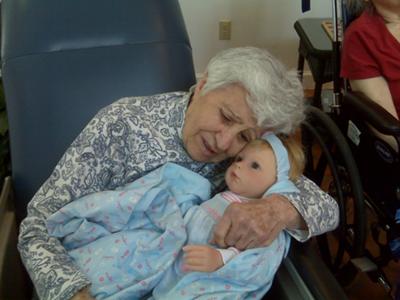
And she was given a baby doll, a move that seemed so jarring that a supervisor initially objected until she saw how calm Ms. Nance became when she rocked, caressed and fed her “baby,” often agreeing to eat herself after the doll “ate” several spoonfuls.

With virtually no effective medical treatment for Alzheimer’s yet, most dementia therapy is the caregiving performed by families and nursing homes. Some 11 million people care for Alzheimer’s-afflicted relatives at home. In nursing homes, two-thirds of residents have some dementia.

Caregiving is considered so crucial that several federal and state agencies, including the Department of Veterans Affairs, are adopting research-tested programs to support and train caregivers. This month, the Senate Special Committee on Aging held a forum about Alzheimer’s caregiving.

“There’s actually better evidence and more significant results in caregiver interventions than there is in anything to treat this disease so far,” said Lisa P. Gwyther, education director for the Bryan Alzheimer’s Disease Research Center at Duke University.

Link to full New York Times Article


Reporting Elder Abuse

Posted by Meredith Williamson

Member, Senior Resource Alliance Northwest


The abuse of our elderly population is a growing problem.  Abuse can take on many forms.  It can occur anywhere. Often it goes unreported if it is perpetrated by a relative or close friend of the elderly person.

What is Elder Abuse?  For the purpose of Oregon State law regarding elderly abuse, an elderly person is defined as anyone over the age of 65.  Abuse includes:

  • A physical injury to the senior not resulting from an accident;
  • Neglect that leads to physical harm;
  • Abandonment;
  • Caregiver neglecting duties and obligations owed to an elderly person;
  • Wilful infliction of physical pain or injury;
  • Use of derogatory or inappropriate names, phrases or profanity, ridicule, harrassment, coercion, threats, cursing, intimidation or inappropriate sexual comments or conduct of such a nature as to threaten significant physical or emotional harm to the elderly person or person with a disability.
  • Certain sweepstakes promotions;
  • Wrongfully taking or appropriating money or property; or
  • Sexual contact that is not agreed upon by the elderly person.


Should I report? You are mandated by law to report abuse if, while you are acting under an official capacity, you have reason to believe that any senior with whom you come in contact has suffered abuse, or  is the perpetrator of the abuse.  Persons who may be acting in “official capacity” include health care professionals, employees of DHS, mental health providers, firefighters, etc.

Even if you are not required by law to file a report, if you see or have reason to believe abuse is happening, you should file a report.  Just like with any criminal behavior, it is best to report the suspected abuse and let the people who are trained investigate it.  If you file a report of suspected elder abuse, and you do so in good faith, you will be protected from potential civil liability that could otherwise result from the report.

How do I make a report? Call your local Department of Human Serices (DHS) or law enforcement agency in the county where the abuse occurred.  You will be asked the names and addresses of the elderly person and any persons responsible for the care of the elderly person, the type of abuse you are reporting, names of perpetrators or description if names are not known, and any other helpful information you can think of.  A list of the DHS (Area Agency on Aging) offices can be found in the Choice Senior Resource Guide or online at http://www.oregon.gov/DHS/spwpd/offices.shtml.

Adult Protective Services will arrange for immediate protection of the senior, assess the senior’s ability to participate in the investigation and arrange for services to prevent future abuse.

June 15th is National Elder Abuse Awareness Day.  Help spread the word about the issue of abuse by sharing this post or visiting www.ncea.aoa.gov to see how you can volunteer in your area.

For a free copy of the Choice Senior Resource Guide, please call Meredith at 503-353-7870 or order copies online.


Are You the Primary Caregiver of an Elderly Loved One?

Posted by Meredith Williamson

Member, Senior Resource Alliance Northwest


If you are the primary Caregiver for an elderly family member or friend and are feeling overwhelmed and stressed, you are not alone.  The primary Caregiver is generally responsible for maintaining two households, including:  shopping, cleaning, laundry, yard and house upkeep.  Additionally, they must arrange and transport their elderly loved one to multiple doctor appointments, ordering and managing medications, paying bills and balancing accounts.  It is mentally, emotionally and physically demanding.

Caregivers not only spend time at the doctor for their loved ones, they themselves experience health issuees at a greater rate than non-caregivers.  They also tend to lose time at work resulting in reduced salaries and benefits.

If you are the primary Caregiver of an elderly loved one, it is important that you take time for yourself, too.  Adult Day Programs offer respite for you and socialization for your loved one.  Other options such as a move to Senior Housing or In Home Care means the everyday things can be taken care of and you can spend more quality time with your loved one without bearing the weight of their care needs.

For more information about Senior Housing, Adult Day or other programs that are available, please call Choice Senior Services, LLC at 503-353-7870 or email help@choiceoregon.com.

www.ChoiceSeniorServices.com


Helping Seniors Eat Right When Money is Tight!

Posted by Judith Auslander, MA – Senior SNAP Outreach

Rising food prices have put a lot of pressure on budgets.  Many seniors are going hungry or are eating foods that are less nutritious.  If you know of someone who needs help, *SNAP (Supplemental Nutrition Assistance Program), may help.  Currently only 1 out of every 3 eligible seniors is receiving the food assistance they deserve.


SNAP FACTS

  • Single monthly income limit is $1,723.  Two-person household is $2,333.  Income levels increase with more people in your household.  Note:  Check with a worker - medical costs or other deductions may help you qualify.
  • For most households, resources such as cars, homes, and/or savings or retirement accounts  do not affect eligibility.
  • You can qualify if you are working, unemployed or retired.
  • You may qualify even if you live with other people.
  • Interviews can be done by phone.

SNAP helps your community

  • SNAP dollars support your community, local business owners and stimulate the local economy.  In 2011, more than $1 billion federal dollars were returned to Oregon through SNAP.
  • There are enough SNAP dollars for everyone who needs them.
  • Just like debit cards – The Oregon Trail EBT card can be used at grocery stores and many
    farmers’ markets.

Other Benefits

  • With SNAP you qualify for telephone bill assistance (with most phone companies)
  • You may also qualify for vouchers for farmers’ markets and most roadside farm stands.

Call SAFENET at 800-723-3638 or dial 211.
For more information go to www.oregonhunger.org

*Formerly known as Food Stamps

Judith Auslander, MA – Senior SNAP Outreach, Partners for a Hunger-Free Oregon
(503) 595-5501 x7 – judith@oregonhunger.org


Family Caregiver Support – 2012 Webinar Series

Blog Post by Portland-Area Offices of Home Instead Senior Care

The 2012 Family Caregiver Support Web Seminar Series provides access to information and advice from professionals experienced with issues faced by family caregivers.Caring for a senior loved one can bring a sense of fulfillment, but usually not without a few challenges as well. To help you feel a little more confident and equipped in your role as a family caregiver, the Home Instead Senior Care® network is launching the 2012 Family Caregiver Support Web Seminar Series, featuring free monthly seminars for family caregivers on a variety of essential caregiving topics.

The web seminars, hosted in cooperation with the American Society on Aging (ASA), provide tips, information and advice from the perspective of professionals who are well-versed in issues facing families caring for aging loved ones.

Please note, these Family Caregiver Webinars are not eligible for CEU credits. The CEU credit offering is only available for the webinars featured in the Professional Family Caregiver series.

Please pre-register for any Family Caregiver Webinar by the deadline of 9 PM PST the day before! for the following 2012 Senior Care Web Series. Please click each “Register Now” link below for more details of each webinar and to sign up.

Living at Home with Arthritis – Family Caregiver Webinar
Wednesday, March 21, 2012 | 10:00 AM Pacific / 11:00 AM Mountain / 12:00 PM Central / 1:00 PM Eastern. Register Now.

How to Help your Senior Manage Medications – Family Caregiver Webinar
Wednesday, April 25, 2012 | 10:00 AM Pacific / 11:00 AM Mountain / 12:00 PM Central / 1:00 PM Eastern. Register Now.

Navigating the Senior Care Maze – Family Caregiver Webinar
Wednesday, May 23, 2012 | 10:00 AM Pacific / 11:00 AM Mountain / 12:00 PM Central / 1:00 PM Eastern. Register Now.

Caring for Someone with Alzheimer’s – Family Caregiver Webinar
Wednesday, June 27, 2012 | 10:00 AM Pacific / 11:00 AM Mountain / 12:00 PM Central / 1:00 PM Eastern. Register Now.

Managing the Stress of a Family Caregiver – Family Caregiver Webinar
Wednesday, July 25, 2012 | 10:00 AM Pacific / 11:00 AM Mountain / 12:00 PM Central / 1:00 PM Eastern. Register Now.

How to Balance Work and At-Home Care – Family Caregiver Webinar
Wednesday, August 22, 2012 | 10:00 AM Pacific / 11:00 AM Mountain / 12:00 PM Central / 1:00 PM Eastern. Register Now.

Senior Cognitive Issues – Family Caregiver Webinar
Wednesday, September 26, 2012 | 10:00 AM Pacific / 11:00 AM Mountain / 12:00 PM Central / 1:00 PM Eastern. Register Now.

Helping Seniors with Finances – Family Caregiver Webinar
Wednesday, October 24, 2012 | 10:00 AM Pacific / 11:00 AM Mountain / 12:00 PM Central / 1:00 PM Eastern. Register Now.

Helping Seniors with Loss of Independence – Family Caregiver Webinar
Wednesday, November 28, 2012 | 10:00 AM Pacific / 11:00 AM Mountain / 12:00 PM Central / 1:00 PM Eastern. Register Now.

Multi-Generational Living – Family Caregiver Webinar
Wednesday, December 19, 2012 | 10:00 AM Pacific / 11:00 AM Mountain / 12:00 PM Central / 1:00 PM Eastern. Register Now.

Get more information and pre-register on any webinar above. You may also Email info@asaging.org or call 415-974-9600 if you have questions about registering for or accessing a recorded webinar.


WSJ Highlights Caregiver Resources from Genworth, AARP, and Home Instead

Blog Post by Portland-Area Offices of Home Instead Senior Care
Content from February 18, 2012 article in the Wall Street Journal, Family Value Section

Caring for an elderly relative isn’t just costly and time-consuming—studies show it could even harm your own health. Now, some companies and nonprofits are rolling out free and low-cost professional help for family caregivers.

Genworth Financial, a large long-term-care insurer, and AARP, the membership group for older Americans, on Thursday introduced a new service for AARP members through which the families of older adults with dementia and other illnesses can assess their needs and develop a care plan—either online, over the phone or in person with a registered nurse.

……….

The new service, formally known as AARP Caregiving Help and Advice from Genworth ranges from $12.99 for six months of online access to $149 for a phone assessment, a service plan and six months of online access, to $489 for an in-home consultation. Adding the “service finder” option—which includes researching local availability, providing quality ratings, negotiating discounts and coordinating the start of care—brings the phone total to $295 and the in-person bill to $665.

……….

Home Instead Senior Care, for its part, is trying to help caregivers—both its own 70,000 paid workers and the public—better meet the needs of people with Alzheimer’s.

“Rather than trying to force Alzheimer’s patients to live in our world in the here and now,” Home Instead’s Mr. Huber says, “we need to meet them in the past.”

For example, one of Home Instead’s clients in Omaha, Neb., where it is based, had served in the military. To persuade him to take a bath—something Alzheimer’s patients often have an aversion to—his caregiver told him a general was coming for inspection and he needed to get ready. He immediately took a bath, Mr. Huber says.

Such simple strategies, he adds, can help people with Alzheimer’s prolong their time at home as well.

By the end of this year, all of the company’s 600-plus franchised locations expect to offer Alzheimer’s training for caregivers. And in May, it plans to post an online course at the Help for Alzheimer’s Families website, which already has other resources.

These new programs come on top of free services offered by the U.S. Administration on Aging’s Eldercare Locator, which connects older adults and families to local agencies, and the nonprofit National Council on Aging’s BenefitsCheckUp site, which provides screening for more than 2,000 public and private programs.

Link to full Wall Street Journal article


Zero Space Gifting for Seniors?!

Post by Stephanie Carter,  Attorney at Law, with Draneas & Huglin,  P.C.

Member, Senior Resource Alliance Northwest

Do you ever feel overwhelmed by your personal possessions?  Do boxes occupy every inch of storage space?  Are you trying to downsize?  Do friends and family members keep giving you more “stuff?”

A few years ago I downsized from a 2400 sq. ft. home to one that was 800 sq. ft.  For months I stored my personal library, artwork, and other possessions in my brother’s huge attic.  Finally, his wife decided she needed the space.  At that point, my living room turned into a box repository.  Having to squeeze through a narrow path to reach the kitchen suddenly made it easier to give up 2/3 of my books.  The public library’s bookstore benefitted, and I received a tax deduction.  Each time I sorted through the boxes, I was psychologically ready to part with more of my possessions, many of which had been gifts to me.

Out of this experience, I developed the concept of “zero space gifting.”  My adult family members and friends, man of whom also felt overwhelmed by their stuff, were glad to adopt my new practice.  None of us needed more stuff.  We agreed that we would only give each other “zero space” gifts.  In other words, gifts that did not take up space or were disposable.  For example, one friend and I  purchased memberships for each other to the Portland Art Museum.  This gift occupied no space in our homes, was an activity we both enjoyed, and encouraged us to spend more time with each other.  Other friends, who read mysteries, purchase the current mystery, pass it around to anyone who wishes to read it, and then donate it to the public library.  (Hint:  I was a librarian in my former career.)   Other zero space gifts could include iTunes cards, a bouquet, specialty dip mixes or vinegars, a bottle of wine, or a coupon for a massage or exercise class.

As an estate planning and elder law attorney, I work with a lot of families who must clear out the family home, either because a senior family member is moving to assisted living or is deceased.  Zero space gifting, mixed with a healthy discard policy, can help ease the burden on family members during these periods of transition.  When a family member moves to assisted living or a foster care home, their space will be extremely limited.  Zero space gifting is ideal for these individuals. 

Does the concept of zero space gifting sound attractive to you?  Mention it to your “donees.”  They will likely be relieved. 

Stephanie Carter, Attorney at Law, Draneas & Huglin, P.C., 4004 Kruse Way Place, Suite 200,
Lakes Oswego, OR, (503) 496-5509, Stephanie@draneaslaw.com

The What, Why, When, Where, and How of Caregiver Help at Home

Blog Post by Mike Brunt

A couple of weeks ago, I had the pleasure of taking part in a seminar series put on by Penny Holcomb at Hearthstone at Murrayhill. My presentation to the seniors and their adult children was titled, “Life’s Easier with a Little Help from a Friend,” and was a sort of primer on in-home care.

One of the common misperceptions about in-home care is that only seniors still living in their own private homes need to hire caregivers to provide extra help. People often don’t realize that the cost of living in a retirement community doesn’t normally include any one-on-one help for the seniors. Whether the help is in the form of standby shower assistance, medication help, or driving to shopping and appointments, seniors living in retirement communities often still need support to maintain their independent lifestyles.

Another big question for families needing support from caregivers is “Should I find and hire a caregiver, or should I use an agency like Home Instead Senior Care?” The loving family friend who is currently unemployed may be able and willing to provide paid caregiving services. But, what about her payroll taxes and health insurance. Worse yet, what if she accidentally breaks a valuable antique or gets hurt on the job? It’s important for families to realize that when they directly hire caregivers, they put themselves in the position of “employer” with all its attendant risks and responsibilities.

If you know of a group who would like me to hear my presentation, please let me know by calling 503-530-1527. My slides below contain some good resource links.

Mike Brunt Presentation – Life’s Easier with a Little Help from a Friend (PDF)

You can find more about the basics of in-home care by downloading this printable guide called The Home Care Solution.


I Can’t Get Ready to Move to a Retirement Community In A Week!

Post by Kim Megorden, CRTS, with KARE Transitions, LLC

Member:  Senior Resource Alliance Northwest

Betty was ready to move into a Retirement Community–or so the Marketing Director thought.  The move date was set, the movers had been booked, and the new apartment was ready.  Betty was not.  She had lived in her home for 30 years and had a lot of memories to sort through.  She could not accomplish this in a week.

So, the Retirement Community called a Senior Move Manager who got in touch with her right away.  Betty was very agitated and stressed.  She was convinced that all of the work that had to be done could not happen in this short time frame.   The Move Manager assured her that it could be done.

When the Move Manager arrived at Betty’s home the following day, Betty was quite distressed.  Standing in her living room, looking around, Betty was overwhelmed.  So, they started by sorting through Betty’s artwork to determine which pieces she would like to take with her.  For the next three hours, they went from room to room together, choosing and tagging the items to be moved.  Betty enjoyed talking about the things they were sorting–every piece had a story.  The Move Manager listened while she sorted and tagged.  Everything was clearly labeled for the movers so they would know where it would be placed in the new residence.  A copy of the floor plan and the color codes for the tagging system was taped to the refrigerator.  An area was set up for the Estate Sale service with items to be sold.  The Move Manager packed some items to be shipped to Betty’s family.  When they finished, Betty was all smiles.  What she thought was impossible now looked very doable.  She gave the Move Manager a big hug and thanked her.  Betty said, “I am ready to move; I am going to take a nap!”

If you are faced with the daunting task of sorting and packing a lifetime of memories, a Senior Move Manager can make this task a lot easier and more enjoyable.  The Move Manager works with clients to get everything sorted and packed according to their wishes.  They work closely with the Movers, Estate Sales, Realtors and Retirement Communities to ensure that all needs are covered for the clients. 

Kim Megorden, CRTS, (503) 819-2650, www.karetransitions.com

My Doctor wants me to sign a POLST form. What’s a POLST?

Post by Stephanie Carter, Attorney at Law, with Draneas & Huglin, P.C.

Member, Senior Resource Alliance Northwest

Clients who visit my office for estate planning assistance frequently bring with them a POLST form that they received from their doctor.  They want to know if they should complete the form.  My answer to their questions will vary, depending on their health circumstances.

The acronym POLST stands for “Physician Orders for Life Sustaining Treatment.”  Some form of POLST is available in the majority of states.  The POLST is designed to be used by individuals who suffer from a terminal or life-limiting illness.  The form allows a person to express his or her wishes with regard to receipt of:
1.   Cardiopulmonary resuscitation (CPR);
2.   Degree of medical intervention; and
3.   Tube feeding.

For example, when a terminally ill person decides not to pursue life-saving treatment or opts for hospice, a brightly colored POLST will be posted in one or more prominent places in the residence (often attached to the front door of the residence and the bedroom door) to alert medical personnel to the fact that the person does not want to be resuscitated and that natural death should be allowed to occur.

To be valid, a POLST form must be signed by the individual’s attending physician, physician’s assistant, or nurse practitioner.  The POLST form becomes an official part of the individual’s medical record and may be registered with the Oregon POLST registry
(http://www.ohsu.edu/polst/programs/OregonPOLSTRegistry.htm).   The POLST follows the person wherever he or she receives medical treatment, be it in a healthcare facility, home or hospice center.

A POLST form is fully amendable.  Individuals can change their wishes at any time and are free to request medical treatment different from what is on the POLST form.  Further, individuals can grant a representative the ability to modify or revoke the POLST form in the event the individual becomes incapacitated.

The POLST complements the Advance Directive and is not intended to replace it or other estate planning (will, trust, power of attorney, etc.)  An Advance Directive is necessary to appoint a legal health care representative and provide instructions for future life-sustaining treatments.  The Advance Directive is recommended for all adults, regardless of their health status.  A POLST form should accompany an Advance Directive when appropriate.

For more information about the POLST, an extensive “Frequently Asked Questiions” page is available at http://www.ohsu.edu/polst/patients-families/faqs.htm.

Stephanie Carter, Attorney at Law, Draneas & Huglin, P>C> 4004 Kruse Way Place, Suite 200,
Lake Oswego, OR, (503) 496-5509, http://stephanie@draneaslaw.com

Oregon Transfer-On-Death Deeds: The Good, the Bad, and the Ugly

Post by Stephanie Carter, Attorney at Law, with Draneas & Huglin, P.C.

Member, Senior Resource Alliance Northwest

On January 1, 2012, a new estate planning tool became available to Oregonians–the Transfer-on-Death Deed (TODD).  The new law allows property owners to transfer real property (i.e., real estate) to one or more beneficiaries using a TODD.   The Deed must be recorded while the transferor is still living, but is revocable and does not take effect until the transferor’s death.  This means that the property owner can sell the property at any time during his or her lifetime, automatically revoking the TODD.

Bank accounts, certificates of deposit, investment accounts, life insurance and almost all other assets have long allowed the owner to designate a beneficiary and, thus, avoid probate.  Real property, often the largest asset a person owns, did not allow such a designation.  The new TODD is intended to allow for real property to pass after death without probate.

When used in the right circumstances, a TODD could save the estate money.

As an estate planner, I have several concerns about the use of  TODDs without first obtaining competent legal advice.  Some of these are:

1.  Potential for fraud and elder abuse.  An untrustworthy individual could influence an elderly property owner to sign a TODD in his or her favor.  Such a transfer may defeat the transferor’s estate planning objectives.  The persons who would otherwise have inherited the property would have to bring a court action to defeat the TODD.

2.  18-month Cloud on Title.  When an estate is probated, there is a four-month creditor claim period, and the State of Oregon must be informed of the probate proceeding.  At the end of the claim period, clear title to the property may be transferred.  If a TODD is used, the property may not be transferred for 18 months.  One of the reasons for this longer period is to allow the state of Oregon to learn of the property owner’s death and assert a claim against the property for monies the State paid out for Medicaid care.

3.  Multiple grantors may lead to inconsistent results.  If there are joint grantors, a surviving grantor may revoke the deed after the other grantor’s death.  The revocation may be inconsistent with the deceased grantor’s wishes.

A TODD may or may not be the best tool for you to use to transfer real property at your death.  Consult an estate planning attorney to learn if this option is right for you.

Stephanie Carter, Attorney at Law, Draneas & Huglin, P.C., 4004 Kruse Way Place, Suite 200,
Lake Oswego, OR, (503) 496-5509, stephanie@draneaslaw.com

Who Gets the Tax Deduction When Decedent’s Personal Property is Donated to a Charity?

Post by Stephanie Carter,  Attorney at Law, with Draneas & Huglin, P.C.

Member, Senior Resource Alliance Northwest

When I assist a personal representative in the probate of an estate, the question almost always arises:  Who gets the tax deduction when the decedent’s personal property is donated to a charity?

Most clients assume that the estate gets the tax deduction.  That is incorrect!  Instead, the receipt for the deduction should be passed on to the beneficiary.  So, look at the decedent’s will or trust to see who was gifted the decedent’s personal property.  If the decedent died with no estate planning in place, then you would look at the intestacy statute to see who inherits the estate.

It is also important to remember that a trustee or personal representative (“fiduciary”) should not dispose of personal property to anyone other than the designated beneficiary without authorization.  Sometimes this authorization is provided in the will or trust.
For example, the estate planning document may give the fiduciary discretion to sell personal property and give the beneficiary the proceeds from sale.  In other cases, the beneficiaries may jointly agree that certain items may be donated (e.g., those items that do not sell at an estate sale).

Stephanie Carter, Attorney at Law, Draneas & Huglin, P.C., 4004 Kruse Way Place, Suite 200,
Lake Oswego, OR, (503) 496-5509, stephanie@draneaslaw.com

Lack of Estate Planning Sets the Stage for Conflict

Post by Stephanie Carter, Attorney at Law, with Draneas & Huglin, P.C.

Member, Senior Resource Alliance Northwest

A surprising number of famous people have died without any form of will or trust to direct distribution of their estate.  This has often led to conflicts over the right to control the estate assets, including intellectual property, public image, and other money-producing assets.

For example, Martin Luther King Jr. didn’t have a will when he was unfortunately assassinated.  His estate, which is run now through a corporation established by his children, often struggles to determine what King’s wishes would be.  Decades after the civil rights leader’s death, his children are still trying to sort out matters related to his estate.

Reggae singer Bob Marley left no will when he died in 1981.  Over the past 30 years, the estate has been involved in multiple lawsuits.  Handling Marley’s estate was complicated by the fact that, although Marley died in Florida, he maintained his Jamaican citizenship.  Since Jamaica’s laws of intestacy were not as generous as Florida’s, his advisors decided to prepare an estate plan AFTER HIS DEATH that Marley’s widow then signed.

The Jamaican court sorted out the issue of the falsified will and removed Marley’s widow as administrator of the estate.  The court then had to resolve the issue of who had the right to use the singer’s name, likeness and image in commerce.  About 10 years after Marley’s death, the Jamaican Supreme Court decided that Marley’s heirs possessed this exclusive right.  The heirs include the widow and Marley’s children.  Unfortunately, the list of heirs does not incude siblings.  The estate is now suing Marley’s half-brother for using his image to promote a Miami music festival and restaurant, as he has done for many years.

Swedish author Steig Larsson, known for his Millennium series that includes The Girl with the Dragon Tattoo, also died without a will.  His estate passed to his heirs (brother and father with whom Larsson was not close) rather than his long-time partner, Eva Gabrielsson.  Gabrielsson has refused to release to the estate the partial fourth volume in the book series, has fought for her share of the apartment they shared, and control over Larsson’s literary estate, which she feels better prepared to administer than Larsson’s family  The dispute is still pending.

Although your estate may not be large, and you may not be famous, proper estate planning can help pass your estate to the next generation without the conflicts that occur when money and sentiment are involved.

Stephanie Carter, Attorney at Law, Draneas & Huglin, P.C., 4004 Kruse Way Place, Suite 200,
Lake Oswego, OR, (503) 496-5509, stephanie@draneaslaw.com

“I Will Remember For You” Alzheimer’s Music Video

Blog Post by Home Instead Senior Care offices in the Portland Metro Area

Oh the places you used to go,
All the people you used to know,
The stories that you loved to tell
About a life that you lived so well.
It’s fine, you can rest if you want to.
I will remember for you,
I will remember too.

Music is just a story with a melody. The song “I Will Remember for You” played in the video above tells the story of a couple touched by Alzheimer’s disease. It was written and performed by Home Instead Senior Care staff member Dave Mainelli, and is inspired by all the families who are keeping the memories alive for loved ones experiencing memory loss. Music powerfully communicates emotion and narrative, making it an excellent tool to evoke memories for those living with Alzheimer’s or other dementias.

More about the benefits of music for people with Alzheimer’s disease or other dementias


Website Offers Help for Alzheimer’s Families

Blog Post by Home Instead Senior Care offices in the Portland Metro Area

In my six and a half years of providing caregiving services to seniors at home, I have supported many families affected by Alzheimer’s disease as they struggle to understand and cope with the changes the disease brings to their senior loved ones. My desire is always to help the families know that while their journey will test their emotional and physical stamina, they are not alone and that help is available.

The families I have observed who were most centered in facing Alzheimer’s disease were the ones who had an understanding of the nature of the disease and who sought for and found emotional support through peer groups or professionals.

Because knowledge and understanding are so imperative for families coping with Alzheimer’s, I am pleased to refer you to an excellent online resource: http://www.helpforalzheimersfamilies.com.

The site answers questions such as -

  • What is the difference between Alzheimer’s disease & dementia?
  • What are the stages of Alzheimer’s and dementia?
  • Is Alzheimer’s inherited?


But it also goes beyond the basics to provide practical advice on topics such as  -

  • Capturing Memories for Someone with Alzheimer’s or Dementia
  • Alzheimer’s Conversation Tips
  • Creating a Memory Box


If you are a member of a family affected by Alzheimer’s disease, this site is for you. If you know a member of such a family, please do them a favor and point them to this thoughtful resource.

http://www.helpforalzheimersfamilies.com


Hearthstone at Murrayhill Free Seminar Series: “Making Life Choices”

Blog Post by Penny Holcomb, Community Relations Director, Hearthstone at Murrayhill

Printable Flyer

Free Seminar Series for Seniors and Families

A free seminar series is being offered by Hearthstone at Murrayhill, a retirement community located at 10880 SW Davies Road in Beaverton.  The four-week series, titled “Making Life Choices,” is geared toward seniors and their families. Seminars will be held on four consecutive Saturdays, beginning January 14, from 10 a.m. to noon.

The January 14 session, titled “What You Don’t Know…CAN Hurt You,” will feature two local professionals: Lake Oswego Attorney Christopher Young from the Pixton Law Group and Diane Childs from the State of Oregon’s Department of Consumer & Business Services. Mr. Young will focus on common legal issues faced by seniors and their families. Ms. Childs will provide tips on how to protect your money from fraud and identify theft.

Subsequent Saturday sessions (January 21 and 28, and February 4) will feature other local professionals who are familiar with the needs of seniors and their families. They will address such topics as “Creating Family Peace in Times of Turmoil,” “Selling Your Home in a Down Economy,” and “Getting Organized.”