Category: Alzheimer’s and Dementia

“I Will Remember For You” Alzheimer’s Music Video

Blog Post by Mike Brunt

Oh the places you used to go,
All the people you used to know,
The stories that you loved to tell
About a life that you lived so well.
It’s fine, you can rest if you want to.
I will remember for you,
I will remember too.

Music is just a story with a melody. The song “I Will Remember for You” played in the video above tells the story of a couple touched by Alzheimer’s disease. It was written and performed by Home Instead Senior Care staff member Dave Mainelli, and is inspired by all the families who are keeping the memories alive for loved ones experiencing memory loss. Music powerfully communicates emotion and narrative, making it an excellent tool to evoke memories for those living with Alzheimer’s or other dementias.

More about the benefits of music for people with Alzheimer’s disease or other dementias


Website Offers Help for Alzheimer’s Families

Blog Post by Mike Brunt

In my six and a half years of providing caregiving services to seniors at home, I have supported many families affected by Alzheimer’s disease as they struggle to understand and cope with the changes the disease brings to their senior loved ones. My desire is always to help the families know that while their journey will test their emotional and physical stamina, they are not alone and that help is available.

The families I have observed who were most centered in facing Alzheimer’s disease were the ones who had an understanding of the nature of the disease and who sought for and found emotional support through peer groups or professionals.

Because knowledge and understanding are so imperative for families coping with Alzheimer’s, I am pleased to refer you to an excellent online resource: http://www.helpforalzheimersfamilies.com.

The site answers questions such as -

  • What is the difference between Alzheimer’s disease & dementia?
  • What are the stages of Alzheimer’s and dementia?
  • Is Alzheimer’s inherited?


But it also goes beyond the basics to provide practical advice on topics such as  -

  • Capturing Memories for Someone with Alzheimer’s or Dementia
  • Alzheimer’s Conversation Tips
  • Creating a Memory Box


If you are a member of a family affected by Alzheimer’s disease, this site is for you. If you know a member of such a family, please do them a favor and point them to this thoughtful resource.

http://www.helpforalzheimersfamilies.com


Reinventing After a Family Crisis – from More Magazine

Blog Post by Mike Brunt
Article from More Magazine written by Michelle Stacy

When her grandmother could no longer manage by herself, former marketing executive Denise Thomas found her passion: helping the elderly live at home for as long as possible.

On a sultry day in April 2011, Denise Thomas, the owner of Home Instead, a franchise business in Austin, Texas, drives to the home of an elderly client. Ninety-one-year-old Emily Lake moved into her comfortable single-story house five years ago and plans to stay there, thanks to Home Instead’s caregivers, who help her bathe, pay bills, shop, track medications and generally maintain her independence. For Thomas, visits to satisfied clients are the best part of her job.

Link to full article at More.com


Dispute Over Estate of Stieg Larsson Highlights Importance of Estate Planning

Post by Stephanie Carter, Elder Law Attorney with Draneas & Huglin, P.C.

Member, Senior Resource Alliance Northwest

In November 2004, Stieg Larsson, Swedish writer and journalist, died suddenly of a heart attack.  Larsson became famous after his death through the posthumous publication of his Millennium Trilogy (“The Girl With The Dragon Tattoo,” “The Girl Who Played With Fire” and “The Girl Who Kicked the Hornet’s Nest”).  Today, these books have sold more than 20 million copies in 41 countries and have been made into movies.

Larsson lived for 32 years with the architect Eva Gabrielsson.  They never married; they had no children; and he did not leave a will.  Swedish law makes no provision for common-law marriage.  Under the Swedish law of intestacy, Larsson’s entire estate was inherited by his Father and Brother, from whom he was estranged.

This disposition of Larsson’s estate sparked a bitter dispute between Larsson’s Father, Brother and Eva Gabrielsson.  Gabrielsson claimed that Larsson’s Father and Brother Larsson “were never a part of our lives” and that they are unsuited to handling his estate–including the valuable copyrights.

Larsson’s former workplace, Expo, owns the computer on which is stored the partial manuscript for the fourth book in the Millennium series.  Larsson’s Father and Brother own the contents of the computer.   However, Gabrielsson currently is in possession of the computer and has so far refused to hand it over.

Negotiations between the parties began in November 2009, but were broken off the following month when Gabrielsson announced she had declined a ”settlement” offer of about 2 million euros from Larsson’s estate (which is now valued in the tens of millions of euros).  The dispute remains unresolved.


Practical Application Under Oregon Law

The situation described above is unfortunately all too common.  The outcome under Oregon law would be similar to that of Sweden in this context. If a person dies with no will, the deceased person’s probate estate wil pass to members of his or her family in the order of priority listed in the statute.  If assets like bank accounts, certificate of deposit, and life insurance list beneficiaries, the asset will pass to the listed beneficiary.  If no beneficiary is listed, the asset becomes a part of the probate estate.

The problem also arises when a deceased person signs estate planning documents, but never updates them and does not regularly (every 3-5 years) check the beneficiary designations on assets that do not pass by will or trust.

It is very difficult when I have to tell a client that he or she will not share in a loved one’s estate because of outdated documents.  Do you have estate planning in place?  If so, how long has it been since you updated it?

Stephanie Carter, Draneas & Huglin, P.C., 4004 Kruse Way Place, Suite 200,
Lake Oswego, OR, (503) 496-5509, Stephanie@draneaslaw.com


Maryville Memory Care Open House Sept. 29

Blog Post by Michael Kilbury, Maryville Memory Care Administrator

The Sisters of St. Mary of Oregon cordially invite you to attend the dedication of Maryville Memory Care

Join us for an afternoon of celebration on
Thursday, September 29, 2011 from 3:00 to 5:00 p.m.

Guests will tour the facility and light refreshments will be served.

Directions:
Take Farmington Rd. and turn north on 148th Ave. onto the campus. The Maryville Memory Care entrance is off of 148th Ave. across from Valley Catholic Elementary & Middle School and behind Maryville Nursing Home.


Printable Event Flyer


Michael Kilbury
Direct: 503-718-5381
Main: 503-643-8626
Fax: 503-520-1435


Book: “Moments This Good, The Softer Side of Alzheimer’s”

Book Recommendation by Mike Brunt

Bonnie Nester’s latest book, ”Moments this Good: The Softer Side of Alzheimer’s,” is a memoir of hope and love.  Join Bonnie as she walks beside her mother through the tangled trails of Alzheimer’s Disease. In “Moments this Good,” Bonnie shares her experiences and insights in a tender and a lovingly humorous way. This is an uplifting, encouraging read to guide others who are losing loved ones to this debilitating disease. Moments This Good gives back the humanity and dignity that Alzheimer’s tries to steal. 

A Portion of the proceeds for this book are donated to the Alzheimer’s Association.

If you would like to purchase a signed and/or personalized copy of any of her books, contact her directly.  She also welcomes any comments – she loves hearing from fellow readers: bonnie@bonnienester.com.

Publication Date: May 2008
ISBN: 9780980244601
208 Pages
26 Black & White Photos
Golden Quill Publishing

Order “Moments this Good”

Read an Excerpt
Bonnie lives in Sherwood, Oregon and is a supporter of Senior Provider Information Network. Learn more about Bonnie and her work at http://www.bonnienester.com/.

Advice for Family Caregivers with Feelings of Resentment

Blog Post by Dr. Amy D’Aprix – March 28, 2011

Question: 

My mom is in a memory care unit 30 minutes away. I make plans to see her two to three times a week. The facility is wonderful and takes good care of her. Many times, when I leave, I feel resentful for her taking so much of my time. I am the primary care person for her. My sister and brother support me but live out of state and cannot get here to see her often. Is this feeling of resentment normal?

Dr.  Amy: 

In my experience, caregivers feel a wide range of emotions. Love, feelings of giving back, gratitude for the opportunity to provide care—as well as anger, resentment, and guilt. All of these feelings are normal.

If your resentment is tied to the number for visits, maybe you have too much on the go and need some help. Are two to three visits a week too much? Perhaps you can do fewer. Or maybe you can hire a home care worker to visit mom once a week, in your place. That would lessen your load. Home Instead Senior Care CAREGivers perform this service. They can go to the memory care facility, keep your mom company and also take care of errands she may have.

At some point, most caregivers need a break from their responsibilities. You might want to hire someone to take over your visiting responsibilities for a week or two. You might also plan to take a break when your brother and sister come to town. Or both!  

If you are feeling a lot of resentment, you may want to get help. As caregivers, each of us has a unique relationship with the person we’re caring for. Often, our feelings today are colored by what happened in the past. If you think this is true for you, a support group or counsellor can help you sort out your feelings and feel more at peace.

More advice from Dr. Amy

Discovery Doubles Genetic Clues to Alzheimer’s

Post by Ann J. Curley, CNN Medical Assignment Manager
Link to article on CNN blog

Discovery Doubles Genetic Clues to Alzheimer’s

Two new reports in Nature Genetics detail the discovery of five new pathways for detecting Alzheimer’s disease, the memory-stealing brain illness that is especially prevalent among the elderly.

Previous research had identified five genes linked to Alzheimer’s disease, or AD. The combined efforts of an international consortium of researchers has raised those known genetic markers to 10.

“We’ve really doubled the number of clues we have about late-onset AD. We have a lot left to do to complete the story of AD genetics, but this is a big step,” said Professor Gerard D. Schellenberg of the University of Pennsylvania, lead researcher for one of the studies.

“Almost as important as the genes discovered is the fact that a large number of investigators are working together to solve the genetics of AD,” Schellenberg said. “We just started an international consortium, IGAP (International Genomics of Alzheimer’s Project), so all the groups that produced both papers are now collaborating.”  IGAP includes scientists from four university research groups and creates a shared database that includes genetic information for more than 40,000 patients.

“Of course, I am a bit biased, but I think this is a big deal,” Schelleberg said.

While the new genetic findings are far from being a cure for Alzheimer’s, Dr. Bill Thies, chief medical and scientific officer of the Alzheimer’s Association praised the findings of both studies, noting their strong methods.

“In the genetics world we’ve had a history of small samples,” Thies said. “The fact that we’ve confirmed some genes in a large group means that it’s real, not a statistical anomaly.” The IGAP will continue to share genetic findings, he said, with the hopes  their research findings will offer keys to unlocking information about all of the routes that Alzheimer’s takes in the body. “The more pathways that we can explore will allow us to make progress for preventing and treating AD eventually.”

Schellenberg said research is at a “critical point” in Alzheimer’s treatment.

“Much attention has been focused on therapies that target A-beta production,” better known as brain deposits that cause plaques and tangles, gumming up the brain’s machinery, he said. But the new genetic findings look at new pathways that merit further study, including one that confirms a previous theory that focuses on the metabolism of cholesterol. Another important theme in the new research is that  “innate immunity” is important in relation to disease susceptibility. That’s the theory that  Alzheimer’s could be part of the body attacking itself because it perceives a threat to its protective immune system.

“This is a really important idea that needs to be followed up,” he said.

5.2 million Americans are currently living with Alzheimer’s disease, according to the Alzheimer’s Association, which estimates that by 2050, as many as 16 million Americans will have the disease.

CAREGiver Vignette: “You Can’t Go Outside Like That!”

Post by Mike Brunt

One of my wonderful CAREGivers wrote to me about the following experience she had with our client.

CAREGiver Vignette: “You Can’t Go Outside Like That!”

My client, Helen, has Alzheimer’s disease. She requires constant attention, redirection, and verbal cueing. Her elderly husband, Paul, recently had back surgery. One day when Helen and I returned from a walk, Paul was lying on his back in the living room to relieve the pressure on his back. He was wearing only an undershirt and boxers.

After his rest, Paul felt refreshed and decided to check on his tomato plants on the patio, only a few yards away from the golf course greenway. Golfers were right outside, ready to tee off. Helen cautioned him, “You can’t go outside like that!” I thought, “Good for her! She’s very aware today!”

Helen scurried to the bedroom and returned with a clean pair of black socks and black dress shoes. “Should I have brought the brown ones?” she worried. Paul and I shared a smile and assured her she had done very well. Then we all walked out to check on the plants together. Black sox, dress shoes, boxers and all.

Congress Endorses a National Plan to Combat Alzheimer’s

With Alzheimer’s Patients Growing in Number, Congress Endorses a National Plan

By PAM BELLUCK
Original Article Published in the New York Times: December 15, 2010

Congress has voted unanimously to create, for the first time, a national plan to combat Alzheimer’s disease with the same intensity as the attacks on AIDS and cancer.

The bill, expected to be signed by President Obama, would establish a National Alzheimer’s Project within the Department of Health and Human Services, to coordinate the country’s approach to research, treatment and caregiving.

Its goal, the legislation says, is to “accelerate the development of treatments that would prevent, halt or reverse the course of Alzheimer’s” and “improve the early diagnosis of Alzheimer’s disease and coordination of the care and treatment of citizens with Alzheimer’s.”

The project would include an advisory council of representatives from agencies like the Centers for Disease Control and Prevention, the National Institutes of Health, the Department of Veterans Affairs, the Food and Drug Administration, the Indian Health Service and the Centers for Medicare and Medicaid Services. Scientific experts, health care providers and people caring for relatives with Alzheimer’s would also be included.

“If you go to war, you have planning, planning, planning,” said Representative Christopher H. Smith, Republican of New Jersey, who co-sponsored the bill. “Well, this is a war on a dreaded disease. We need to bring all the disparate elements together for the greatest possible result.”

While the act itself does not authorize more money, one of the recommendations of the national plan “is likely to be for an increase in research money for Alzheimer’s,” said another co-sponsor of the bill, Senator Susan Collins, Republican of Maine.

“We spend one penny on research for every dollar the federal government spends on care for patients with Alzheimer’s,” she said. “That just doesn’t make sense. We really need to step up the investment.”

The legislation was driven by the rapidly rising number of people with Alzheimer’s — about 5.3 million now, and expected to triple by 2050. The cost of their care to Medicare and Medicaid was about $170 billion last year. By 2050, Ms. Collins said, it will grow to $800 billion a year, more than the military budget.

The House passed the bill on Wednesday, and the Senate last Thursday.

The advisory council would draft an annual report on federally financed programs involving research, treatment, nursing homes and home care, recommending which to expand or eliminate. It would also ensure that members of ethnic and racial groups at higher risk for Alzheimer’s be included in research and treatment.

Alzheimer’s experts said the effort could make a significant difference.

“What really makes this so powerful is that it takes us from a lot of small efforts going on locally to doing something in a coordinated way,” said Dr. Kenneth Kosik, a neuroscientist at the University of California, Santa Barbara. “If there’s one thing we know in science it is that to draw conclusions we need numbers, large-size populations to study.”

The national plan will reinforce efforts to detect brain changes that occur years before people develop symptoms of dementia, and to develop drugs to prevent or substantially delay symptoms.

“Dealing with symptoms only after the fact is not going to solve the problem,” said Dr. Zaven Khachaturian, a former director of Alzheimer’s research for the National Institutes of Health. Delaying symptoms for just five years, he said, “we will cut down tremendously” on the number of people who live long enough to develop Alzheimer’s.

Representative Edward J. Markey, a Massachusetts Democrat who co-sponsored the bill, said his mother had had Alzheimer’s. “We’re trying to create a sense of urgency so that we’re developing multiple pathways that ultimately might be successful,” he said. “We’ve done it with polio, we’ve done it with AIDS.

“It’s a unique disease to the extent that patients can’t lobby for themselves, and the person close to them cannot lobby because they’re home taking care of that person. There are no Alzheimer’s survivors.”

A version of this article appeared in print on December 16, 2010, on page A26 of the New York edition.

Six Things to Look for When Visiting Elderly Parents

Blog Post by Lynne Coon, MS

If you live far away from your aging parents, the holiday season is often the one time you may see them all year. Enjoy your visit and use the opportunity to check to see how they’re coping.

1. The condition of your mother and father’s home. If things don’t look clean or you see stacks of paperwork, magazines, or other stuff sitting around this may be a sign that they’re not keeping up. Ask them how they’re doing. It might be a good time to explore whether they could use a housecleaner or are ready to move to a smaller living space.

2. Food in cupboards, refrigerator and freezer. How much food is in the cupboards and refrigerator? Are things outdated? Is the freezer full of frozen dinners? Food preparation is often one of the first things to fall by the wayside for an older adult.

3. Covert messages from friends and neighbors. If you have an opportunity to speak with your parents’ close friends and neighbors, listen closely for anything they may be trying to communicate. They may be torn between not wanting to meddle and feeling concerned so they may not give you direct information. If you suspect something is different about your parents ask friends and neighbors if they think anything is different. They may be looking to you for a signal that it’s okay to share their concerns.

4. How your parents are in social situations. Are they happy, present in the conversation, aware of what’s going on around them? Or do they look overwhelmed or confused? If your parents spend a great deal of time alone, being around a large group of people can be overwhelming. If they seem this way throughout your trip or no matter how small the group they’re around, it might be cause for further investigation.

5. Opportunities to interact with their medical professionals. If there’s an opportunity to tag along to a medical appointment do it. While HIPPA prevents medical staff from sharing information with you without your parents’ permission, if you go into the room when they see the doctor you can hear what’s being discussed and ask any questions you have. This might also be a good time to ask your parents for permission to talk with medical staff. (This requires that they sign a release specifically listing you as someone their doctor can share information with. Explain to your parent’s that it would be helpful to be able to talk to their doctor in an emergency.

6. Driving skills. Be a passenger in the car with your parent. Simply observe his/her comfort level behind the wheel, how she/he responds to traffic situations and if he/she shows any signs of confusion. You may need to allow for the fact that just you being in the car may make her/him nervous.

If you discover things that concern you, don’t jump to the conclusion that your parent is slipping. For example, in #1-#4 above, the changes you see may not be the result of your parents getting older and frail but of drug interactions or depression. Some next steps might be to discuss your concerns with your parents; find out what medications your parents are on and do your own research on drug interactions; encourage them to talk to their doctor about drug interactions or a depression screening; consider whether a neurological evaluation would be helpful; visit again, sooner rather than later if you have any concerns, and continue to monitor.

Enjoy your time with family this holiday season!

Lynne Coon, MS — counselor serving communities in the greater Portland metropolitan area including: Portland, Vancouver, Lake Oswego, Tigard, Tualatin, Beaverton, Milwaukie, Oregon City, Hillsboro, Forest Grove, King City, West Linn, Wilsonville, Gresham, Troutdale, Scappoose, St Helens, Camas, Brush Prairie, Battle Ground, and Multnomah County, Clackamas County, Washington County and Clark County.

7 Types of Normal Memory Problems

Blog Post by Mike Brunt

Content from Harvard Health Publications, Harvard Medical School - Link to Article

Forgetfulness — 7 types of normal memory problems

It’s normal to forget things from time to time, and it’s normal to become somewhat more forgetful as you age, but it’s not normal to forget too much. But how much forgetfulness is too much? How can you tell whether your memory lapses are within the scope of normal aging or are a symptom of something more serious?

Healthy people can experience memory loss or memory distortion at any age. Some of these memory flaws become more pronounced with age, but — unless they are extreme and persistent — they are not considered indicators of Alzheimer’s or other memory-impairing illnesses.

Seven normal memory problems

1. Transience
This is the tendency to forget facts or events over time. You are most likely to forget information soon after you learn it. However, memory has a use-it-or-lose-it quality: memories that are called up and used frequently are least likely to be forgotten. Although transience might seem like a sign of memory weakness, brain scientists regard it as beneficial because it clears the brain of unused memories, making way for newer, more useful ones.

2. Absentmindedness
This type of forgetting occurs when you don’t pay close enough attention. You forget where you just put your pen because you didn’t focus on where you put it in the first place. You were thinking of something else (or, perhaps, nothing in particular), so your brain didn’t encode the information securely. Absentmindedness also involves forgetting to do something at a prescribed time, like taking your medicine or keeping an appointment.

3. Blocking
Someone asks you a question and the answer is right on the tip of your tongue — you know that you know it, but you just can’t think of it. This is perhaps the most familiar example of blocking, the temporary inability to retrieve a memory.  In many cases, the barrier is a memory similar to the one you’re looking for, and you retrieve the wrong one. This competing memory is so intrusive that you can’t think of the memory you want. A common example is calling your older son by your younger son’s name, or vice versa.

Scientists think that memory blocks become more common with age and that they account for the trouble older people have remembering other people’s names. Research shows that people are able to retrieve about half of the blocked memories within just a minute.

4. Misattribution
Misattribution occurs when you remember something accurately in part, but misattribute some detail, like the time, place, or person involved. Another kind of misattribution occurs when you believe a thought you had was totally original when, in fact, it came from something you had previously read or heard but had forgotten about. This sort of misattribution explains cases of unintentional plagiarism, in which a writer passes off some information as original when he or she actually read it somewhere before.

As with several other kinds of memory lapses, misattribution becomes more common with age. Age matters in at least two ways. First, as you age, you absorb fewer details when acquiring information because you have somewhat more trouble concentrating and processing information rapidly. Second, as you grow older, your memories grow older as well. And old memories are especially prone to misattribution.

5. Suggestibility
Suggestibility is the vulnerability of your memory to the power of suggestion — information that you learn about an occurrence after the fact becomes incorporated into your memory of the incident, even though you did not experience these details. Although little is known about exactly how suggestibility works in the brain, the suggestion fools your mind into thinking it’s a real memory.

6. Bias
Even the sharpest memory isn’t a flawless snapshot of reality. In your memory, your perceptions are filtered by your personal biases — experiences, beliefs, prior knowledge, and even your mood at the moment. Your biases affect your perceptions and experiences when they’re being encoded in your brain. And when you retrieve a memory, your mood and other biases at that moment can influence what information you actually recall.

Although everyone’s attitudes and preconceived notions bias their memories, there’s been virtually no research on the brain mechanisms behind memory bias or whether it becomes more common with age.

7. Persistence
Most people worry about forgetting things. But in some cases people are tormented by memories they wish they could forget, but can’t. The persistence of memories of traumatic events, negative feelings, and ongoing fears is another form of memory problem. Some of these memories accurately reflect horrifying events, while others may be negative distortions of reality.

People suffering from depression are particularly prone to having persistent, disturbing memories. So are people with post-traumatic stress disorder (PTSD). PTSD can result from many different forms of traumatic exposure — for example, sexual abuse or wartime experiences. Flashbacks, which are persistent, intrusive memories of the traumatic event, are a core feature of PTSD.

Link to Article

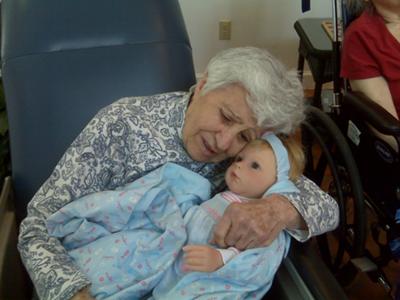
Baby Doll Therapy for Memory Care Residents

Blog Post by Robyn Hosier
Robyn is the Resident Care Coordinator at Clare Bridge Beaverton

Baby Doll Therapy for Memory Care Residents

The Spectrum of Behaviors and Emotions
Day by day we see residents that exhibit a complete spectrum of behaviors and/or emotions.  Situations that arise in the early morning, will certainly give way for something new by the afternoon.   This goes hand in hand with delivering quality dementia and Alzheimer’s care.  Providing an environment that allows for these rapid, daily changes is a challenging and daunting task. As well as, learning how to provide “happiness” and “comfort” to a person with a declining mental state.

Happiness Defined
Happiness can be defined as simply as this, “the satisfaction of needs.”  The needs, however, can change from age to age, year to year and goal to goal.  In dementia care, finding the need that triggers “comfort” can make the difference in dealing with a difficult behavior and a “happy” resident.  Pinpointing what a person requires to be happy and comforted is a talent that caregivers can learn through observation and application.  “Comfort” can be explained best by saying, “to lighten the burden.”  That may leave a lot to the imagination, but can be interpreted as easily as saying, “to make feel better.”

Each Resident – A Unique Individual
When introducing different therapies to residents, it will always enhance your skill set to learn as much about the resident as possible.  Learning what they were like before the Dementia or Alzheimer’s, and since the onset, can prove successful when trying to implement a plan that provides comfort and happiness.  Not every concept will work for every resident.  Remember that each person, prior to diagnosis, was a unique individual with likes and dislikes, talents and skills.  This has not changed.  Each resident is still a unique individual.  Some things do not differ from their essential personality.  It will be your job to learn and determine what will compliment their current needs.

Innate Capacity for Love and Nurturing
The ability to love and the desire to be a needed and useful, contributing member of any society is part of our basic nature.  Our capacity for love and nurturing is, by far, the strongest, innate basic need we have.  This “need” can be utilized to provide comfort and happiness for the dementia/Alzheimer resident. Even when the proficiency of speech and the dexterity of movement have left, love and nurturing can still be a deep desire that needs to be fulfilled.  That fulfillment can provide brief, or not so brief, moments that are  needed for a resident’s mental success.  Brief moments that they may not remember, but  moments that gave them comfort and happiness.   This is why I utilize “Baby Doll Therapy.”

Everyone Loves Babies
On any given day, it becomes apparent that someone is overly agitated, someone is aggressive, someone is non-verbally acting out, someone is reluctant to accept care, someone appears depressed, someone is more confused than usual or someone just needs to be busy with something.  Everyone loves babies.  Male and female residents both benefit from seeing a baby or a child.  When families bring their children or grandchildren or even great grandchildren, the residents will come alive with smiles.  Even when they can’t remember who their visitors are, they remember youth.

Universal Emotional Needs
Introducing baby dolls can provide moments when the resident can love and nurture another human being.  The doll has a symbolic meaning and provides purpose and healing for people with dementia.  Residents will often provide immediate feedback regarding what you do or say.  Or, what they do or see.  A baby doll can satisfy a universal emotional need that isn’t often fulfilled.  Studies show that there are 5 significant emotional needs: 

1)  To feel needed and useful

2)  To have the opportunity to care

3)  To have self-esteem boosted

4)  To love and be loved

5)  To express emotions freely

Baby doll therapy can easily accomplish the satisfaction of these needs.  Never does a person feel more accomplished than when caring for someone/something else.  For a lot of my residents, it’s baby dolls.  For others, it’s a stuffed animal that may remind them of a favorite pet.  Both offer a comforting measure and happiness that allows the resident, even in a demented state, to feel as if they are providing and fulfilling a need for someone else.  This is enormous in magnitude when you consider that these residents are completely dependent on others for their own care.  Baby dolls, stuffed animals and the like, let them feel needed instead of always being “in need.”

Case Study – Nadine
Let’s take a look at Nadine.  Nadine came to us after having lived in her own home for 60 years.  Her husband had died several years before.  Family had decided that “mom” wasn’t able to live on her own any longer.  Her dementia had progressed to a point that she was unsafe to be living without supervision.  It was a tough decision for the family.  Guilt and worry clouded their minds and they obsessed over leaving their mother in this new unfamiliar place.  Nadine, however, reacted like most new residents entering a memory care community, with retaliation!

Nadine had been a school teacher for many years.  She had raised her children, tended to the needs of her husband and when he had passed away, she ran her house.  She swam and walked daily.  She cooked her own food, cleaned her house and minded her financial interests.  This is clearly a woman that had been in control for many years.  She began to try and run “our house,” so to speak.  She, still being able to communicate fairly well, was telling other residents where to go and what to do.  She found a dry erase marker (bright red) and began writing her “lessons” on the walls of the community.  She prattled on endlessly about how we were all bad children, residents and staff included, because we didn’t listen to her teachings.  She would write us notes of how to improve our business.  Although the notes were mostly nonsense, to Nadine they showed structure and organization.

Hoping to find just the right balance, her medications were adjusted and readjusted by her physician.  Some changes proved successful, others not so much.  In dementia care, we realize that medications cannot fix everything.  We still train to be knowledgeable in the things that medications cannot help with.  We provide interventions that are resident specific, things that they can relate to from their own personal history. 

Well after all the pharmacology and the personal attention, we offered Nadine a baby doll that had been donated.  At first, she thought the baby was mine, as I had asked her to baby-sit for me.  She held the “baby” carefully and was bright as the afternoon sunshine when she stared at the baby’s face.  She spoke to the doll and coddled it like a new mother.  Pretty soon, the baby was hers.  She would find small articles of her own clothing to swaddle around the baby.  She would share her food with the baby.  That is somewhat messy but messes can be cleaned.  She would discuss mothering techniques with other residents and proudly announce that this was her son, even when “he” was dressed all in pink.  To Nadine, this was an area in her life that she had control over.

As time went by, Nadine’s unusual behaviors subsided.  Her attentions were focused on taking care of the baby and not lecturing all of the other residents on how to be good students.  Her demeanor became gentle and she would exchange pleasantries with staff.  Her conversational skills were a bit of “word salad” but pleasant none the less.  Staff began to provide necessities for her and the baby.  A new t-shirt, tiny little diapers, a bottle, a diaper bag and even a stroller.  This was an experiment that proved beneficial for both the staff and the resident.  Everyone was involved in helping Nadine tend to this little baby.

After generating successful results, we began trying this with other residents.  Although this does not work for every resident, it has proved to be a positive experience for most of them.  We included male residents in this assay.  We found that while the males do not necessarily “dote” over the babies like the females, they do find comfort in feeling the infant effigy lying in their arms.  One gentleman will hold the doll during meal times.  We find that if he is holding the baby, he eats more.  This is a man who has had weight loss and is on hospice.  Getting him to eat better has increased his strength.

Results – Pleasing and Surprising
In the beginning we were concerned over what family members might think, after all we don’t want to diminish the dignity of a grown adult.  We found that most families were pleased and surprised at their loved one’s attachment to a doll or stuffed animal.  Most wished they had thought of it themselves.  Now, we are finding that families are bringing in dolls and animals for their mom, dad, grandma, grandpa, etc.  What started off as an attempt to redirect difficult behaviors has turned into a constructive use of creative therapy. 

Living In The Moment
Alzheimer ’s disease and Dementia is a grueling end to what should have been a perfect life.  The seconds of clarity, the moments of reminiscing, the security of knowledge will all become parts of the past, which, too, will be forgotten.  In a memory care community, you should be living in the exact moment that you are in.  Offer that moment to your residents and make it special.  It may be forgotten all too quickly, but for an instant, you provided something that made a personal connection.  How priceless the moment is!

Home Safety for Seniors with Alzheimer’s and Other Types of Dementia

Blog Post by Mike Brunt

Last month, a friend referred me to a web site with information and products to enhance the safety and comfort for people with dementia who are still living at home.

http://www.thiscaringhome.org/

My interest was piqued since a good number of my in-home care clients suffer from Alzheimer’s or other dementing illnesses. One of the main questions families have is how to make home a safe place when the aging loved one can’t be relied upon to exercise caution and good judgment.

Dementia victims also often suffer from anxiety and fears that rob them of peace of mind and can contribute to other problems with their physical and mental health (blood pressure, heart issues, depression). I’ve observed that with dementia clients, one of the main goals is to prevent emotional escalations through distraction, re-direction, and also practical tools.

This web site, www.thiscaringhome.org, is full of practical tools to help dementia clients (and their family or professional caregivers) get through the day more easily.

Here are a few of my favorite finds from the site:

  • Bathing Outfit
    • This bathing outfit can restore dignity to the bathing experience while reducing agitation. This special waterproof bathing outfit has a wrap-around skirt and a bib-like top with a Velcro closure. The garment remains on during washing, while you, the caregiver, and the person, wash around and under it. Price is $30 for women and $20 for men.
  • Quilted, Machine-Washable Seat Pads
    • These quilted waterproof pads are made out of nylon and polyester and have a vinyl waterproof backing. Machine washable.May reduce embarrassment and shame that often occurs when regular incontinence pads are used. Available in several colors. This gives you more options to choose a color that also contrasts with the floor color. This make’s the seat more visible to people with dementia, as many have problems with depth perception. Price is $20
  • 5 Common Environmental Triggers for Agitation
    • People with dementia are extremely sensitive to their surroundings. But not everyone is bothered by the same stimuli or events, so the first step is to find out what’s upsetting the person you care for. The next time the person is agitated, take a look at or think back to exactly what happened just before they got agitated. Then you can remove or change the trigger(s) and the associated agitation. You’ll both experience less stress and, hopefully, a calmer day. Here are five common environmental triggers known to cause agitation in persons with dementia… 


The site also has tips from experts such as “Sometimes it’s small things, like a grandchild giving a safety product as a gift, that makes all the difference in how well a product is received.”

As a final note, I think this is a great resource that I think will come in handy for anyone working with senior loved ones with Alzheimer’s or other dementing illnesses.

If you have found other products or tips that were effective for dementia care at home, please comment on this blog post.

Laughter Yoga

Blog Post by Paul Perry
As a returning student, Paul is pursuing his Encore Career through PCC in the Gerontology field with special interest in Memory Care for Alzheimer’s and dementia-challenged people.  He has worked as an Eligibility Assessment and Verification Specialist with the San Diego County Department of Social Services and later as a Licensed Oregon Land Surveyor.

Health Benefits of Laughing and Laughter Yoga

As part of my internship as a Life Enrichment Associate with Hearthstone at Murrayhill, in their Memory Care area I have been creating and leading in some of the group activities for the residents.  One idea I had was to use some of the fun I had at the Laughter Yoga club at PCC where I learned how to laugh for no other reason than the health benefits it brings to all of us.  Laura Lou Pape-McCarthy is the organizer who every week inspires club members to spread the word.

When I first started with a small group of dementia challenged people some did not understand why we would laugh out loud for no other reason but to have fun.  But since the goal is to recapture some of that child-like fun we had when we were younger, they began to see how good it makes us feel to exercise those laughter muscles we may not use for days at a time, as well as the refreshing feeling we all get through healthy breathing techniques that go along with the laughter yoga routine.

Some of the residents had difficulty understanding “the point” of laughing our loud for no reason.  Others were tickled by the idea right away.  Quite honestly it is the less cognitively impaired ones who didn’t understand.  The more advanced residents just did what others were doing and liked it.  The exercises all start with deep unified breathing just like many of the morning get-moving type activity that groups do.  The exercises are modified for memory care as most are sitting down with some in wheelchairs and others using walkers so the movements are not as extreme as in the regular Laughter Yoga gatherings where we walk around and move our arms a lot.

The routines all have names and they help to set the stage for each exercise.  Like “Aloha Laughter” where the group collectively says out loud “Aloooo, ha, ha, ha, ha”.  That is, saying the word together and then using the “ha” part of the word to begin laughing out loud, “Ha, ha, ha, ha, etc..”.  Sounds kind of crazy but its really a lot of fun.  Part of the fun is taking a deep breath in together and then, saying the Aloha word together and then, laughing together while looking at each other’s eyes and laughing and making the moment fun.  Afterwards everybody feels good.  Trust me, I’ve seen it.

Another routine is called “Vowel Laughter” and is based around the group saying each vowel sound (a, e, i, o, u and sometimes y) and turning the “a” sound into laughter that sounds sort of like “hey, hey, hey, hey…” and then the “e” sound into laughter that sounds sort of like “tee, hee, hee, hee…” and through each of the vowels.  For example the “o” sounds like Santa Claus “Ho, ho, ho, ho…” and on.  

The idea with these “exercises” is to make yourself laugh out loud with everyone else.  That’s the hard part at first but it gets easier each time you all do it together.  There are some videos of Laughter Yoga on YouTube.com.  Just type in Laughter Yoga!

The local website is www.LYInstitute.org (Laughter Yoga Institute).

Paul W. Perry
Gerontology Student
PCC, Sylvania Campus

Family Caregiver Vignette by Jean Blackburn – “Mother’s African Violets”

Blog Post by Jean Blackburn
who recently completed her gerontology studies at Portland Community College

My Mother loved her flowers.  She had about 8 pots of African violets that were doing extremely well, and she always took great care of them.  The first thing I noticed was that the violets weren’t looking as good.  Then I noticed that the medication in her pill container wasn’t always taken.  It was very confusing to try to figure out what she had really been taking.  I decided to stay all night with her for a few nights to see how things were going in her routines as I had a feeling she was trying to conceal what was going on.  I didn’t say anything to her about checking up on her, but just that I thought it would be fun to have a slumber party now and then.  After a few “slumber parties,” I had to admit that she was failing a lot.

Mother had been living 5 minutes from my home after moving from Corvallis to Portland to be with her kids.  After selling her home, she had a beautiful, new apartment which she had wanted for a long time. She loved having her own place where she didn’t have all the responsibilities.  She thrived there for a few years.  Then complications started with hip and back problems which required many doctor visits and consultations before proceeding with hip replacement.  There were many other health challenges which meant many interruptions from Mom’s worried neighbors. These events required immediate action from me.  I was single and self-employed.  My siblings both worked at full-time jobs they found hard to get away from.  I was the one who usually handled such things in the family, so the expectation was that I would do so.  That’s the way it had always been.  

I had been very fortunate to have a wonderfully loving and attentive Mother, so I enjoyed getting to be there for her.  However, I needed to make an income; and with self-employment, time and momentum are extremely important.  The most challenging thing for me was seeing Mother realize that she was failing.  She knew she was repeating a lot and that she didn’t have the same energy and “get-up-and-go.”   She had some depression.  She knew her older sister and Mother had Alzheimer’s in their 90’s and that she was almost 90.  I knew I needed to be stable and consistent for her, but my emotions were not that.  Most of the time I was able to act like all was well and do what I needed to do to insure her comfort and safety.  But it was draining.

I remember one particular time where I really “lost it” with Mother.   I know it’s not atypical, but it is still something I regret.   My best outlet was exercise and my closest friends.  My son was away at college and then married and living in another state.   I was used to being the one “who could handle everything well.”   I had no extra time to even think.   I was mentally and physically exhausted. 

One Friday, Mom called at the end of the day to ask me to take her to the emergency room as she had been choking all day and couldn’t swallow without something coming back up—even saliva.  She was frightened.  She had waited to try to get my brother to help her.  She was always trying to “even out” the care she required so that it all didn’t fall on me and my sister.   My brother wasn’t available.  After finding out that she had a hiatal hernia that was causing the problem, they “stretched” her esophagus, and that worked for quite a while.  I distinctly remember this day, because it was the start of a real decline in Mother’s health.  Whereas I kept thinking things would get better, they mostly did not.  It was the beginning of a 10-year decline until she passed 3 ½ years ago.   I had already made a big investment in time with Mother’s care, and many more “opportunities” were yet to come. 

Mother needed less responsibility, help with medications, someone around to make sure she had good meals, more socialization to help with the depression, and a safer place to live (no burners).  Her dementia was getting worse. She helped to pick out the next place she would live which was an independent living facility 10 minutes from my home.  That worked reasonably well. I had tried to get Mother to move in with me. I wanted to sell my home and move us both to a one level. I even took her with me to look at a few homes I thought might be suitable for us to live in together, but she would not hear of it.  I even asked a counselor Mother had talked to about her depression to help me convince her that she should live with me; she told me Mother absolutely did not want that. 

Mother wasn’t so good at being able to “receive.”  She was a “giver.” Though she wasn’t living with me, I was still “on call” as Mother had several falls and one was quite severe; but no broken bones.  Her dementia got worse.  She wasn’t confident enough to engage new friends, and one lady at her meal table was very aggressive which bothered Mother.  I tried to facilitate her developing friendships.  More and more she preferred being alone.  As her dementia continued to get worse, I was there a lot.  It eventually got to the point where she needed more care, and we moved her to a bright and cheery assisted living facility. This time, it was in a location in a geographical area that was about the same distance from each of the homes of me and my siblings, so that it wouldn’t be so handy for me to be “the one.” 

Mother liked the new place, although she had some “hallucinations” that were sad. Since it had been difficult to get my siblings involved in all that was required for Mother’s care, I requested they meet with me and a counselor I had been talking with to discuss it. My sister and brother-in-law were there, as well as my brother, and my closest spiritual girlfriend who was just a “listener.” The Counselor was very effective in letting them know that I couldn’t do it all any more, that it had been a huge physical, financial and emotional hit for me the last 5 years, etc. She got their commitment to become more involved. My brother never did. My sister and her CPA husband took care of the finances from then on.  I was still involved in most everything else, but I was No. 2 rather than No. 1. They called my sister first when Mother had a TIA (she had several), for example.  The two of us took turns every week with the grooming, showering, etc., which worked a lot better. 

I really enjoyed getting Mother all squeaky clean and feeling good. One of my life-long friends, who didn’t work, and a young friend of Mother’s helped out immensely. When we couldn’t do something because of our schedules, they would fill in. They visited her often because they enjoyed her. Friends are so helpful in such situations. But the responsibility is still on “you.” We were at the facility a lot to be with Mother, take her on rides, out to dinner, to family activities, etc. She had been diagnosed with mild to moderate Alzheimer’s at OHSU, and it became more apparent in her behavior as time went on. But she always knew us when we called or when we came to see her. 

Since Mother passed, I continue to be very interested in the “aging” field which is why I went back to school and am embarking on an encore career in gerontology at the age of 66. I have been doing a lot of volunteering also, as I learned so much from my experience with Mother. It’s easier when you aren’t so close to the seniors as you don’t have an expectation as to how they “should be.” You can just “be” with who they are. I feel very good about how we cared for Mother, but also have learned a lot about what we didn’t know and am learning new things with new research. Hopefully I can put that knowledge to use in helping others to have fewer hurdles to navigate. Recently I got a card from my son, for no special occasion, telling me that “Grandmother would be proud of what you are doing.” He had a special relationship with his Grandmother. That was worth a lot!